 EN
EN

2026 Cleaning Products Export Trends: What Buyers Need to Know
Time : 2026-06-26
2026 Cleaning Products Export Trends: What Buyers Need to Know
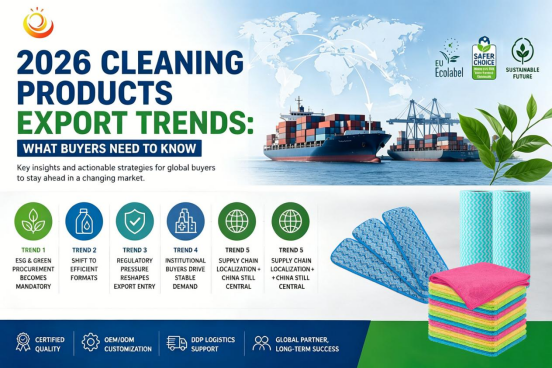
The global cleaning products industry is entering 2026 with a clear message: compliance, sustainability, and efficiency are no longer optional—they are the new baseline for international trade. For importers, distributors, and facility suppliers, understanding these shifts is critical for staying competitive in the US, EU, and emerging markets.
As a professional manufacturer and exporter, Zhejiang E-Sun Enviromental Technology Co., Ltd. closely monitors these global transitions to help buyers align with the latest procurement standards and market expectations.
1. Global Market in 2026: Stable Growth, Higher Expectations
The cleaning products sector continues to grow steadily in 2026, driven by hygiene awareness, healthcare demand, and institutional cleaning expansion.
Industry data shows that the global cleaning products market is now in a multi-hundred-billion-dollar scale with steady annual growth, while demand is shifting from basic cleaning to performance + safety + sustainability combined solutions .
At the same time, buyers are becoming more selective:
Price competition remains intense
But certification and compliance matter more than ever
Long-term supply stability is replacing short-term sourcing
2. Trend #1: ESG & Green Procurement Becomes Mandatory
One of the strongest export drivers in 2026 is ESG compliance.
Global buyers—especially in Europe and North America—are now requiring:
EU Ecolabel / EPA Safer Choice alignment
Biodegradable materials
Low-carbon manufacturing documentation
Reduced packaging waste
ESG-driven procurement now accounts for a significant share of market growth, making it one of the most influential purchasing criteria in institutional cleaning categories .
What this means for exporters:
If your product is not:
eco-certified
transparent in ingredients/materials
compliant with chemical regulations (REACH, etc.)
It will gradually lose access to premium buyers.
3. Trend #2: Shift from “Bulk Cleaning” to “Efficient Formats”
A major transformation in 2026 is the move toward efficient cleaning formats, including:
Disposable microfiber systems
Concentrated cleaning formats
Single-use hygiene solutions
Pre-measured cleaning tools
This shift is driven by:
Labor cost increases
Efficiency pressure in facility management
Demand for reduced water and chemical usage
The market is clearly moving toward “less effort, more output” cleaning systems, especially in healthcare, hospitality, and commercial cleaning segments
4. Trend #3: Regulatory Pressure Is Reshaping Export Entry
In 2026, regulations are no longer background requirements—they are market entry barriers.
Key regulatory drivers include:
EU chemical safety frameworks (REACH compliance)
Microplastic restrictions
Packaging waste directives
Hospital hygiene standards in institutional procurement
For exporters, this means:
Compliance documentation is now as important as product quality itself.
Many importers now require full traceability, including:
Material origin
Testing reports (SGS, OEKO-TEX, etc.)
Manufacturing process transparency
5. Trend #4: Institutional Buyers Drive Stable Demand
While retail markets fluctuate, B2B institutional buyers remain the most stable growth segment.
High-demand sectors include:
Hospitals and healthcare facilities
Hotel and hospitality chains
Industrial cleaning contractors
Food service sanitation systems
These buyers prioritize:
Consistency of supply
Certification compliance
Cost efficiency at scale
Long-term supplier partnerships
This is especially important for exporters targeting the US and EU procurement systems.
6. Trend #5: Supply Chain Localization + China Still Central
Even with diversification strategies, China remains a core manufacturing hub for cleaning consumables due to:
Mature supply chains
Large-scale OEM/ODM capabilities
Cost efficiency
Rapid customization ability
However, buyers are now demanding:
Faster lead times
DDP logistics options
Transparent pricing structures
Multi-country warehousing support
ESUN continues to support global buyers with flexible OEM/ODM production and export-ready supply chain solutions.
7. What Buyers Should Prioritize in 2026
To stay competitive in global sourcing, buyers should focus on:
✔ Compliance-first sourcing
Choose suppliers with proven certifications and audit readiness.
✔ Sustainability verification
Do not rely on marketing claims—request documentation.
✔ Total landed cost transparency
Include shipping, tariffs, packaging, and hidden logistics costs.
✔ Scalable supply partners
Avoid fragmented sourcing—prioritize integrated manufacturers.
8. ESUN Perspective: What We Are Doing in 2026
As a global supplier, ESUN is adapting to these export trends through:
Expanded certified product lines (OEKO-TEX, ISO, SGS tested)
Eco-material innovation for microfiber and nonwoven products
Automated production for consistent quality
Custom OEM/ODM solutions for distributors
DDP and cross-border logistics support for US/EU buyers
Our goal is to help global customers reduce sourcing risk while improving compliance readiness and cost efficiency.
Conclusion
2026 is not just another growth year for the cleaning products industry—it is a structural transformation year.
The winners in global trade will be those who:
Align with ESG requirements
Invest in certified sustainable products
Build long-term supplier partnerships
Optimize total supply chain efficiency
For importers and distributors, now is the time to upgrade sourcing strategies from “price-driven” to compliance + sustainability + scalability driven procurement.