 EN
EN

Hospital Curtain Mesh Explained: How to Choose the Right Height and Design
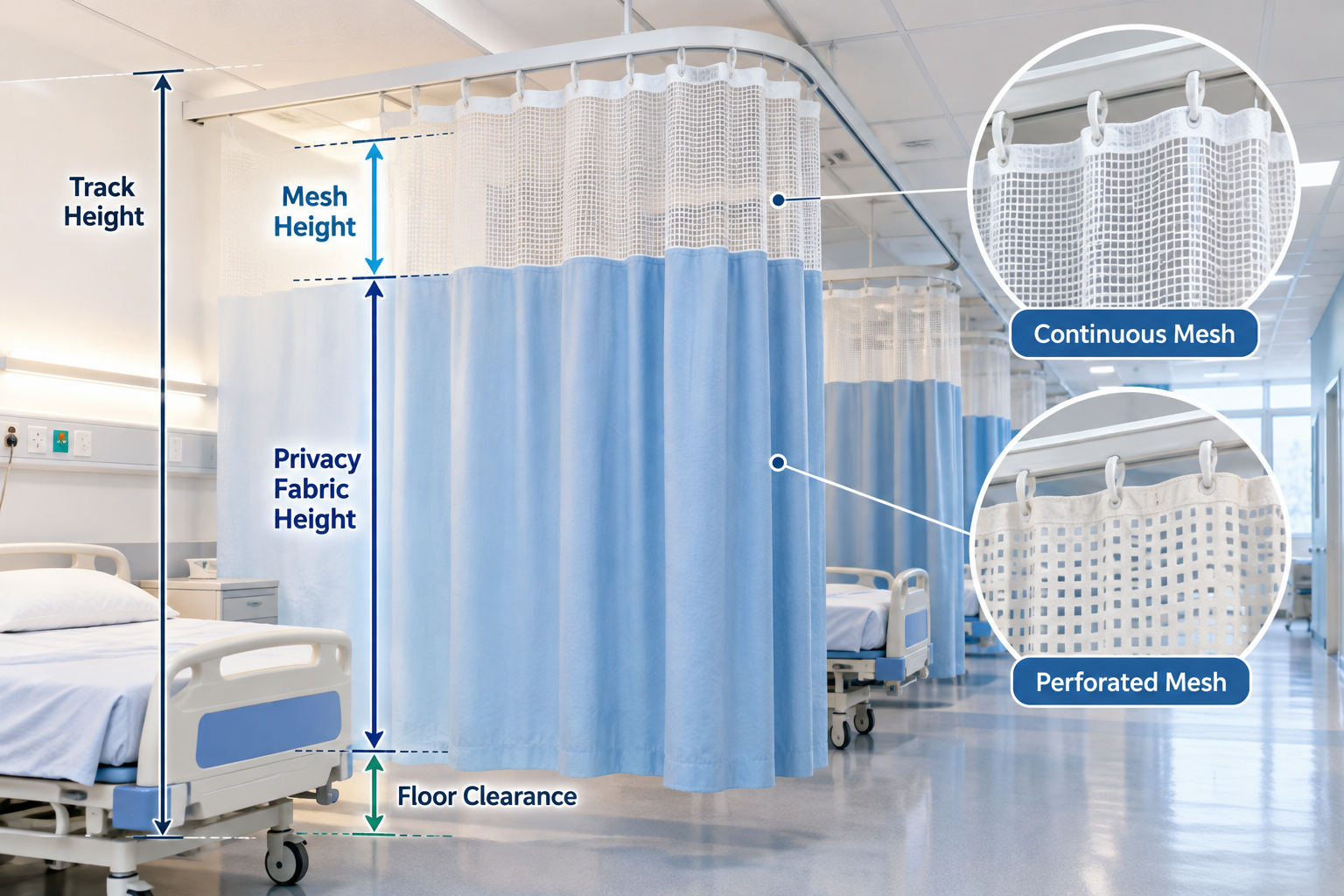
When purchasing a hospital privacy curtain, buyers often focus on fabric, color, fire performance and curtain size.
But one detail can have a major impact on installation:
the mesh at the top of the curtain.
Hospital curtain mesh is not only a decorative feature. It can affect:
-
Air circulation
-
Visibility
-
Sprinkler clearance
-
Ceiling-track compatibility
-
Curtain height
-
Installation efficiency
-
Overall appearance
For hospital procurement teams, healthcare distributors and OEM buyers, choosing the correct mesh height and construction is just as important as selecting the curtain fabric itself.
So how should buyers choose the right hospital curtain mesh?
Short Answer
The correct mesh design depends on the relationship between:
Floor-to-track height + required floor clearance + curtain fabric height + mesh height
There is no universal mesh height that works for every hospital.
For many projects, buyers should first confirm:
-
Ceiling-track height
-
Required curtain clearance from the floor
-
Finished curtain height
-
Required mesh height
-
Sprinkler or ventilation requirements
-
Existing track and hook system
The best curtain design is one that fits the actual room rather than simply following a standard catalog size.
What Is Hospital Curtain Mesh?
Hospital curtain mesh is the open-grid material commonly installed at the top section of a privacy curtain.
It may be connected to:
-
PP nonwoven curtain fabric
-
SMS / SMMS curtain fabric
-
Polyester reusable curtain fabric
The mesh section allows a degree of openness above the privacy panel while maintaining patient privacy below.
Common designs include:
-
Continuous mesh
-
Sewn mesh
-
Perforated mesh
-
Snap-panel mesh systems
-
Integrated mesh sections
The final choice depends on the hospital’s ceiling system and project requirements.
Why Do Hospital Privacy Curtains Need Mesh?
The top portion of a privacy curtain is often left open or constructed with mesh for practical reasons.
1. Air Circulation
A completely solid curtain extending close to the ceiling may reduce airflow between patient bays.
Mesh allows air to move more freely through the upper section of the curtain.
This can be important in:
-
General wards
-
Multi-bed patient rooms
-
Rehabilitation centers
-
Long-term care facilities
2. Sprinkler and Fire-Safety Considerations
Ceiling-mounted sprinklers and other fire-safety systems should not be obstructed by privacy curtains.
Depending on the building code, ceiling height and sprinkler layout, an open mesh section may be required.
Buyers should always confirm local facility and fire-safety requirements rather than assuming one mesh height will meet every project.
3. Visibility and Light
Mesh allows natural and artificial light to pass through the top portion of the curtain.
This helps maintain a brighter patient environment while preserving privacy below.
4. Ceiling Equipment Clearance
Hospitals may have:
-
Sprinklers
-
Ceiling lights
-
Ventilation outlets
-
Nurse-call systems
-
Medical rails
-
Ceiling-mounted equipment
A correctly designed mesh section helps the curtain fit around these systems without creating unnecessary obstruction.
How Is Hospital Curtain Height Calculated?
This is where many purchasing mistakes happen.
Buyers may simply provide:
“We need a 2.0-meter curtain.”
But that is not enough.
The correct calculation should consider the full installation height.
A simple formula is:
Track Height – Floor Clearance = Finished Curtain Drop
Then divide that drop into:
Mesh Section + Privacy Fabric Section
For example:
If the ceiling track is installed at 2.7 m above the floor and the hospital requires 0.3 m clearance from the floor, the finished curtain drop is:
2.7 m – 0.3 m = 2.4 m
That 2.4 m may then be divided into:
0.4 m mesh + 2.0 m privacy fabric
or another combination depending on the project.
This is why mesh height should never be selected independently.
What Is a Typical Mesh Height?
There is no single standard that applies to all projects.
Common mesh heights may vary depending on:
-
Ceiling height
-
Curtain track height
-
Required bottom clearance
-
Sprinkler position
-
Local building requirements
-
Hospital preference
For many projects, the mesh section may fall somewhere around:
30–60 cm
But this should only be treated as a reference range.
Some projects may require:
-
Smaller mesh sections
-
Larger mesh sections
-
Fully customized mesh height
For OEM or hospital tender projects, the safest approach is to calculate mesh height from the actual site dimensions.
How to Choose the Correct Mesh Height
Professional buyers should work backward from the room measurements.
Step 1: Measure the Track Height
Measure the distance from the floor to the curtain track.
Do not use ceiling height unless the track is installed directly against the ceiling.
Step 2: Confirm Required Floor Clearance
Privacy curtains should not drag on the floor.
The hospital may specify a defined clearance for hygiene, safety or cleaning access.
Step 3: Confirm the Privacy Area
The solid fabric section must provide enough patient privacy.
If the mesh section is too tall, the curtain may look visually unbalanced or expose too much of the upper area.
Step 4: Confirm Ceiling Equipment
Check whether the curtain must leave space around:
-
Sprinklers
-
Air vents
-
Lights
-
Medical equipment
Step 5: Finalize Mesh Height
Once these dimensions are confirmed, the supplier can calculate the correct mesh section.
This reduces the risk of curtains arriving too short, too long or incompatible with the room.
Continuous Mesh vs Perforated Mesh
Hospital curtain projects may use different mesh constructions.
Continuous Mesh
Continuous mesh is a separate mesh fabric attached to the top of the privacy curtain.
Advantages may include:
-
Good airflow
-
Clear open-grid structure
-
Professional appearance
-
Easy customization
-
Suitable for reusable and disposable curtains
It is commonly used in traditional hospital privacy curtains.
Perforated Mesh
Perforated mesh may be produced by creating openings directly in the upper nonwoven material.
Advantages may include:
-
Simplified construction
-
Lower component count
-
Lightweight design
-
Easy production for disposable curtains
This option can be useful for certain disposable curtain systems.
Which Is Better?
Neither is universally better.
Choose continuous mesh when:
-
Appearance matters
-
A traditional hospital curtain design is preferred
-
Reusable or premium curtain systems are used
Choose perforated mesh when:
-
Disposable use is the priority
-
Lightweight construction is preferred
-
Simpler production and replacement are important
Mesh Design for Disposable Hospital Curtains
For disposable privacy curtains, mesh should support fast installation and replacement.
Common requirements include:
-
Lightweight construction
-
Secure attachment
-
Stable shape
-
Easy folding and packaging
-
Compatibility with curtain hooks
PP and SMS disposable curtains can be produced with:
-
Sewn mesh
-
Integrated perforated mesh
-
Continuous mesh
-
Custom mesh height
For large healthcare projects, mesh design should also consider packaging volume.
Bulky or stiff mesh may increase carton size and transport cost.
Mesh Design for Reusable Polyester Curtains
Reusable polyester curtains often use a more traditional textile mesh.
This can provide:
-
Better drape
-
Durable construction
-
Repeated laundering capability
-
More premium appearance
For reusable systems, buyers should also ask:
-
Does the mesh shrink after washing?
-
Does the mesh maintain its shape?
-
Is the mesh fire-retardant if required?
-
Is the mesh securely sewn to the curtain body?
-
How many wash cycles has the material been tested for?
The mesh should have a service life that matches the curtain body.
What Happens If the Mesh Is Too Short?
A mesh section that is too short can create several problems.
The privacy fabric may extend too high, potentially interfering with airflow or ceiling systems.
It can also make the curtain look visually heavy.
In some projects, insufficient mesh height may cause compliance issues if the installation does not match the facility’s fire or ventilation requirements.
What Happens If the Mesh Is Too Tall?
A mesh section that is too tall can also create problems.
The solid privacy area may become too short.
This can reduce:
-
Patient privacy
-
Visual coverage
-
Overall curtain appearance
For some rooms, a tall mesh section may expose too much of the patient area when viewed from a distance.
This is why the privacy fabric height should be decided first, not the mesh.
How Does Mesh Affect Privacy?
Privacy curtains are designed to create visual separation between patients.
The solid fabric section should cover the main patient zone.
The mesh section should remain above the line of normal patient visibility.
For multi-bed wards, buyers should consider:
-
Bed height
-
Patient head position
-
Visitor standing height
-
Room layout
-
Curtain track height
The objective is to maintain privacy without blocking the entire upper space.
Does Mesh Affect Fire Performance?
It can.
If the hospital requires fire-retardant curtains, the mesh may also need to meet the relevant fire-performance requirement.
Professional buyers should ask whether:
-
The curtain body has been tested
-
The mesh has been tested
-
The finished assembled curtain has been tested
-
The certificate applies to the exact material combination
This is important because a fire-retardant curtain fabric combined with an untested mesh may not meet the intended project specification.
Should the Mesh and Curtain Use the Same Color?
Not necessarily.
Many hospitals use:
-
White mesh with colored curtain fabric
-
Matching mesh and fabric
-
Neutral mesh with printed curtains
White mesh is popular because it looks clean and visually light.
However, custom colors may be used for:
-
Private hospitals
-
Children's wards
-
Rehabilitation facilities
-
Branded healthcare projects
The mesh color should support the overall design without making the room feel closed or visually heavy.
What Should Buyers Ask Before Ordering?
Before approving a hospital privacy curtain with mesh, confirm the following:
1. Track Height
Measure from the finished floor to the track.
2. Finished Curtain Drop
Confirm the total hanging height of the curtain.
3. Floor Clearance
Define how much space should remain between the curtain and floor.
4. Mesh Height
Specify the required mesh section.
5. Fabric Height
Confirm the privacy-panel height separately.
6. Mesh Construction
Choose:
-
Continuous mesh
-
Sewn mesh
-
Perforated mesh
-
Snap-panel system
7. Fire Performance
Confirm the required standard for both fabric and mesh.
8. Hook Compatibility
The curtain top and mesh should match the existing track and hook system.
9. Laundry Requirement
For reusable curtains, confirm whether the mesh can withstand repeated washing.
10. Customization
Check whether the supplier can adjust:
-
Mesh height
-
Curtain length
-
Curtain width
-
Hook position
-
Color
-
Printed design
Hospital Curtain Mesh Selection by Application
| Application | Recommended Approach |
|---|---|
| General Ward | Standard mesh or continuous mesh |
| Isolation Room | Disposable curtain with simple mesh system |
| ICU | Customized mesh height based on track and equipment |
| Emergency Department | Easy-replacement disposable mesh design |
| Long-Term Care | Standard continuous mesh |
| Pediatric Ward | Custom colors or printed fabric with light mesh |
| Reusable Curtain System | Durable sewn polyester mesh |
| Temporary Hospital | Lightweight disposable mesh solution |
The exact specification should always follow the facility's installation requirements.
Common Purchasing Mistakes
Mistake 1: Ordering Only by Curtain Height
A 2.0 m curtain is not enough information.
Buyers also need to specify the mesh section.
Mistake 2: Ignoring Track Height
Curtain dimensions should be calculated from the installed track, not from catalog assumptions.
Mistake 3: Forgetting Floor Clearance
A curtain that touches the floor can interfere with cleaning and may create hygiene concerns.
Mistake 4: Using One Mesh Height for Every Hospital
Different buildings have different ceiling and track systems.
Mistake 5: Ignoring Fire Performance of the Mesh
The mesh should be evaluated together with the curtain body.
Mistake 6: Choosing Mesh Based Only on Appearance
Airflow, equipment clearance and installation requirements are more important than visual design alone.
What Should OEM Buyers Provide to the Manufacturer?
For an OEM hospital curtain project, the technical brief should include:
-
Curtain material
-
Finished curtain height
-
Finished curtain width
-
Track height
-
Floor clearance
-
Mesh height
-
Mesh type
-
Hook or eyelet design
-
Fire-retardant requirement
-
Antimicrobial requirement
-
Printing or Pantone color
-
Packaging requirement
For example:
PP nonwoven disposable privacy curtain, 2.3 m finished height, 40 cm continuous mesh, customized Pantone color, C-hook system, private-label packaging.
This is much clearer than simply requesting:
“Hospital curtain with mesh.”
Frequently Asked Questions
Why do hospital curtains have mesh at the top?
Mesh helps maintain airflow, light transmission and clearance around ceiling systems while preserving privacy in the lower section.
What is the standard height of hospital curtain mesh?
There is no universal standard. Mesh height depends on track height, floor clearance, privacy requirements and local facility specifications.
Is 30 cm mesh enough for a hospital curtain?
It may be suitable for some installations, but buyers should calculate mesh height from the actual track and room measurements.
Can disposable hospital curtains have mesh?
Yes. Disposable PP and SMS privacy curtains can be produced with continuous mesh, sewn mesh or perforated mesh.
Can mesh height be customized?
Yes. Professional manufacturers can customize mesh height according to hospital track and ceiling dimensions.
Does hospital curtain mesh need to be fire retardant?
If the project requires fire-retardant curtains, buyers should confirm whether the mesh and finished curtain assembly meet the required standard.
Is perforated mesh suitable for disposable curtains?
Yes. Perforated upper sections can be a practical option for lightweight disposable curtain systems.
What measurements should I send to the supplier?
At minimum, provide track height, desired floor clearance, finished curtain width and required privacy-panel height.
Final Recommendation for Healthcare Buyers
Hospital curtain mesh should not be treated as a minor accessory.
It affects:
Airflow + Privacy + Ceiling Clearance + Installation + Appearance + Compliance
The safest way to choose the correct mesh is to start with the actual room dimensions.
Use this simple approach:
Track Height – Floor Clearance = Finished Curtain Drop
Then divide that drop into:
Mesh Height + Privacy Fabric Height
For hospitals, healthcare distributors and OEM buyers, customized mesh height is usually more reliable than forcing every project into one standard size.
E-SUN provides customizable hospital privacy curtains in PP nonwoven, SMS/SMMS and reusable polyester materials, with options including continuous mesh, perforated mesh, custom curtain height, digital printing, Pantone colors, hooks, eyelets and snap-panel systems.