 EN
EN

How Many Square Meters Can One Disposable Microfiber Mop Pad Clean?
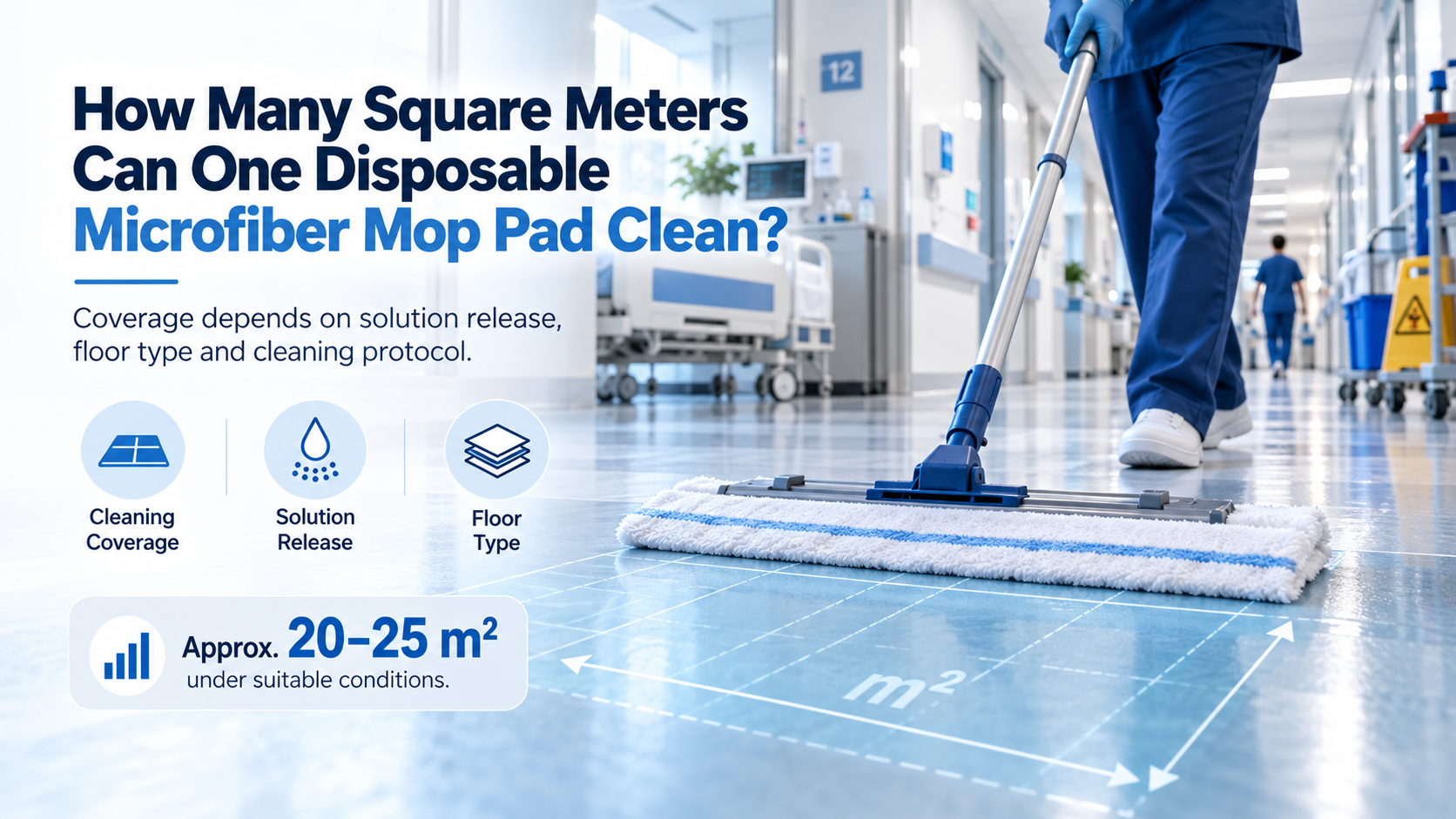
When hospitals and healthcare distributors compare disposable microfiber mop pads, one of the most practical questions is often overlooked:
How many square meters can one mop pad actually clean?
For professional healthcare cleaning, the answer matters because cleaning coverage directly affects:
-
Mop pad consumption
-
Cleaning solution usage
-
Labor efficiency
-
Cost per patient room
-
Cost per square meter
-
Inventory planning
As a general reference, a well-designed disposable microfiber mop pad may clean approximately 20–25 m² under suitable conditions.
For selected E-SUN disposable microfiber mop pads, internal testing has shown approximately 22–23 m² of cleaning coverage per pad under specified test conditions.
However, this number should not be treated as a universal rule.
Actual coverage depends on the mop structure, solution volume, floor type, contamination level and cleaning protocol.
Short Answer: How Much Area Can One Disposable Mop Pad Clean?
For many professional healthcare cleaning applications:
One disposable microfiber mop pad may cover around 20–25 m².
A practical benchmark for certain E-SUN disposable microfiber mop pads is approximately:
22–23 m² per pad under controlled test conditions.
But buyers should always ask how that number was tested.
A mop pad used on a lightly soiled vinyl floor may clean a larger area than the same pad used in a heavily contaminated patient room.
That is why professional buyers should consider:
Cleaning Coverage + Solution Release + Absorbency + Soil Level + Cleaning Protocol
rather than relying on one number alone.
What Does “Cleaning Coverage” Mean?
Cleaning coverage refers to the approximate floor area that one mop pad can effectively clean before it should be replaced.
It is usually expressed in:
Square meters per mop pad (m²/pad)
or
Square feet per mop pad (ft²/pad).
For example:
If one mop pad cleans 22 m², that is approximately 237 ft².
If it cleans 25 m², that is approximately 269 ft².
This gives hospital procurement teams a much more practical performance indicator than GSM alone.
Why Cleaning Coverage Matters to Hospital Buyers
A disposable mop pad may appear inexpensive when evaluated by unit price.
But unit price does not tell you the true cleaning cost.
Consider two products.
Mop Pad A
Lower purchase price
Cleaning coverage: 15 m²
Mop Pad B
Slightly higher purchase price
Cleaning coverage: 23 m²
If the cleaning performance is comparable, Mop Pad B may require significantly fewer pads to clean the same hospital floor area.
For purchasing teams, the more useful metric is therefore:
Cost per Cleaned Square Meter
rather than simply:
Cost per Mop Pad
What Determines How Many Square Meters a Mop Pad Can Clean?
Several factors influence real-world coverage.
1. Cleaning Solution Volume
The amount of cleaning or disinfecting solution loaded into the mop pad is one of the biggest factors.
If the pad contains too little solution, the floor may become insufficiently wetted before the planned cleaning area is completed.
If it contains too much solution, the pad may become unnecessarily heavy and leave excessive liquid on the floor.
The objective is not maximum liquid capacity.
It is controlled solution delivery.
For pre-impregnated healthcare cleaning systems, the supplier and facility should determine an appropriate saturation volume according to the mop design and cleaning procedure.
2. Solution Release Rate
Absorption and solution release are not the same.
A mop may absorb a large amount of cleaning liquid but retain too much of it inside the fibers.
This reduces usable floor coverage.
For professional healthcare cleaning, a good mop should gradually release cleaning solution while moving across the floor.
Selected E-SUN disposable microfiber pocket mop pads have achieved more than 94% solution release in internal testing.
That means the mop is designed not only to hold liquid, but also to transfer a high proportion of that solution onto the cleaning surface.
This can help support more consistent floor coverage.
3. Microfiber Structure
The microfiber surface itself also affects coverage.
A well-designed microfiber structure should balance:
-
Liquid absorption
-
Solution release
-
Soil pickup
-
Floor contact
-
Mopping resistance
A thicker mop is not automatically a better mop.
Likewise, a higher-GSM mop does not automatically clean a larger area.
Two mop pads with similar dimensions can provide different coverage because their fiber structures behave differently.
4. Floor Type
Floor material changes how quickly solution is consumed.
Smooth hospital flooring such as vinyl may allow relatively efficient liquid distribution.
Other surfaces may require more solution.
Coverage can vary on:
-
Vinyl
-
PVC
-
Linoleum
-
Epoxy flooring
-
Ceramic tile
-
Textured safety flooring
Textured surfaces generally create more friction and may require more cleaning effort.
For this reason, suppliers should avoid promising one fixed coverage number for every floor material.
5. Soil Level
A lightly soiled patient-room floor is very different from a heavily contaminated clinical area.
Higher soil levels may require:
-
More mechanical action
-
More cleaning solution
-
Earlier mop replacement
-
Multiple cleaning passes
This reduces the practical cleaning area per pad.
Hospitals should therefore define coverage according to the level of contamination rather than trying to maximize square meters at all costs.
6. Hospital Area
Cleaning coverage should also be considered by room type.
General Patient Rooms
A disposable microfiber mop may provide its normal designed coverage, assuming standard environmental cleaning conditions.
Isolation Rooms
In many facilities, one mop pad may be dedicated to one patient room or defined isolation area.
Even if the mop could technically clean more square meters, it may be discarded earlier to support the facility's cross-contamination-control protocol.
ICU
High-risk environments often prioritize contamination control over maximum pad coverage.
Corridors
Large open floors may allow greater use of the mop's full coverage capacity.
Operating or Controlled Areas
Facilities may establish stricter mop-change protocols regardless of theoretical square-meter capacity.
This is an important distinction:
Maximum technical coverage is not always the same as recommended clinical-use coverage.
Does a Larger Mop Pad Clean More Square Meters?
Not necessarily.
A larger mop pad provides a larger contact area, but floor coverage also depends on liquid management and cleaning performance.
For example, increasing pad dimensions without increasing the appropriate solution volume may cause the mop to dry out earlier.
Likewise, a larger pad that holds too much solution can become heavy and difficult to maneuver.
Professional buyers should evaluate the complete system:
Mop Size + Solution Volume + Fiber Structure + Release Rate + Frame Design
Does Higher GSM Mean More Cleaning Coverage?
Again, not necessarily.
GSM measures fabric weight per square meter.
A higher-GSM microfiber pad may:
-
Hold more solution
-
Feel thicker
-
Contain more textile material
But it may also retain more solution inside the pad.
A lower or medium-GSM structure with efficient solution release may provide equal or greater practical floor coverage.
This is why GSM should never be used as the only purchasing criterion.
For hospital cleaning, a better performance combination is:
Suitable GSM + High Solution Release + Consistent Floor Contact + Proven Coverage
How Much Solution Should a Mop Pad Hold?
There is no universal number because disposable mop pads are made with different dimensions and structures.
The ideal amount should be enough to:
-
Wet the microfiber evenly
-
Provide sufficient surface moisture
-
Support the target cleaning area
-
Avoid excessive dripping
-
Avoid leaving too much unused liquid inside the pad
Professional buyers should ask suppliers for:
Absorption capacity
and
Recommended pre-saturation volume
These are different specifications.
Maximum absorption tells you how much liquid a mop can hold.
Recommended pre-saturation volume tells you how much should actually be used in the cleaning system.
The second number is often more useful operationally.
How Can Hospitals Test Mop Pad Coverage?
Hospitals and distributors do not need to rely entirely on supplier claims.
A simple controlled comparison can provide useful information.
Start with the same:
-
Floor material
-
Floor area
-
Cleaning solution
-
Solution volume
-
Mop frame
-
Operator technique
-
Soil condition
Then compare several mop pads.
Record:
Starting solution volume
Total cleaned area
Floor wetting consistency
Residual solution inside the mop
Mopping resistance
Visual soil removal
The result gives procurement teams a much more realistic picture of practical coverage.
For large-volume purchases, it is worth testing several samples before approving the final specification.
What Is a Good Cleaning Coverage for a Disposable Microfiber Mop Pad?
There is no single international number that defines a “good” mop pad.
But for many professional floor-cleaning systems, approximately 20–25 m² per disposable microfiber mop pad can be a useful reference range when conditions are appropriate.
A mop providing around 22–23 m² can therefore offer practical coverage for many hospital floor-cleaning applications.
However, buyers should ask four additional questions:
Was the test performed using water or disinfectant?
Different liquids can behave differently.
How much solution was added?
Coverage numbers are meaningless without knowing the liquid volume.
Which floor material was used?
Smooth and textured floors behave differently.
When was the mop considered “finished”?
Some tests may continue cleaning long after the floor is receiving enough liquid.
Without these details, comparing two suppliers' coverage claims can be misleading.
One Mop Pad Per Room or One Mop Pad per 20–25 m²?
This is an important question for healthcare facilities.
The answer depends on the cleaning protocol.
In general commercial cleaning, a pad may be used until its effective coverage limit is reached.
Healthcare cleaning often works differently.
A facility may choose:
One Mop Pad = One Patient Room
even when that room is smaller than the technical coverage capacity of the mop.
Why?
Because reducing movement of contaminated cleaning materials between patient zones may be more important than maximizing pad utilization.
For example:
A mop has a potential coverage of 22 m².
A patient room is only 16 m².
The facility may still discard the mop after that room rather than use the remaining theoretical 6 m² somewhere else.
For procurement planning, hospitals therefore need to know both:
Technical Coverage
and
Actual Pads Used per Room
Cleaning Coverage vs Cross-Contamination Control
Trying to maximize square meters is not always the correct goal.
For hospitals, the main objective is safe and consistent environmental cleaning.
A mop should be replaced when:
-
It reaches the defined cleaning-zone limit
-
It becomes heavily soiled
-
It no longer delivers solution consistently
-
Facility protocol requires a new mop
-
The operator moves to another risk area
-
The patient-room procedure requires replacement
This is particularly important in:
-
Isolation rooms
-
ICU areas
-
High-risk patient zones
-
Infection-control cleaning programs
The best disposable mop is not simply the mop that cleans the largest possible number of square meters.
It is the mop that provides predictable coverage within the facility's cleaning protocol.
How Cleaning Coverage Affects Hospital Purchasing Cost
Suppose a healthcare facility needs to clean:
10,000 m² of floor area per day.
If Mop A provides 15 m² per pad:
10,000 ÷ 15 = approximately 667 mop pads
If Mop B provides 22 m² per pad:
10,000 ÷ 22 = approximately 455 mop pads
That is a theoretical difference of more than 200 mop pads per day.
In real hospitals, the calculation will be influenced by room-based mop-change requirements, but this example shows why coverage can have a significant impact on procurement volume.
For distributors and hospital buyers, evaluating cost per square meter can reveal differences that are invisible when only comparing unit prices.
What Should Healthcare Buyers Compare?
When sourcing disposable microfiber mop pads, ask suppliers for more than a product weight and price.
A professional specification should include:
| Specification | What It Tells the Buyer |
|---|---|
| Mop Dimensions | Frame and application compatibility |
| Material | Fiber composition |
| GSM | Fabric weight |
| Finished Pad Weight | Production consistency |
| Absorbency | Maximum liquid capacity |
| Recommended Solution Volume | Practical pre-saturation requirement |
| Solution Release Rate | How efficiently liquid reaches the floor |
| Cleaning Coverage | Approximate usable floor area |
| Microbial Removal Test | Verified cleaning performance, where applicable |
| Chemical Compatibility | Suitability for hospital cleaning agents |
| Scrubbing Structure | Performance on adhered soil |
| Packaging | Storage and logistics efficiency |
This gives procurement teams a much more complete picture.
How Should Medical Distributors Compare Suppliers?
If Supplier A says:
“Our mop cleans 30 m².”
and Supplier B says:
“Our mop cleans 22 m².”
do not automatically assume Supplier A is better.
Ask both suppliers:
-
What solution volume was used?
-
What floor surface was tested?
-
Was the floor consistently wet?
-
What microfiber structure was used?
-
What percentage of solution remained in the pad?
-
Was cleaning performance measured?
-
Was the test repeated across multiple samples?
Reliable performance should be repeatable, not simply based on the best result from one pad.
What Should OEM Buyers Specify?
For OEM disposable microfiber mop projects, do not begin only with:
“We need a 45 cm mop pad.”
A better product brief includes:
-
Target mop dimensions
-
Mop-frame size
-
Pocket or Velcro attachment
-
Target cleaning area
-
Pre-saturation volume
-
Solution release requirement
-
Absorbency target
-
Microfiber structure
-
Scrubbing requirement
-
Color-coded edging
-
Chemical compatibility
-
Packaging quantity
-
Compression requirements
For example, an OEM customer might ask for:
A disposable microfiber pocket mop designed for approximately 20–25 m² healthcare floor coverage with controlled solution release.
That gives the manufacturer a meaningful performance target.
Frequently Asked Questions
How many square meters can one disposable microfiber mop pad clean?
A professional disposable microfiber mop pad may clean approximately 20–25 m² under suitable conditions. Actual coverage depends on solution volume, mop construction, floor type, soil level and cleaning procedure.
Can one mop pad clean an entire hospital room?
Often yes from a technical coverage perspective, but hospital infection-control policies may require one mop pad per room regardless of remaining theoretical coverage.
Is 20 m² good coverage for a disposable mop?
Around 20 m² can be a practical coverage level for many healthcare applications. Buyers should compare coverage together with solution release and cleaning performance.
Does a thicker mop clean a larger area?
Not necessarily. Thickness and GSM can increase liquid capacity, but they do not guarantee efficient solution release or greater floor coverage.
How does solution release affect coverage?
A mop that releases absorbed cleaning solution efficiently can distribute more usable liquid onto the floor rather than leaving it trapped inside the pad.
Does floor type affect mop coverage?
Yes. Smooth floors, textured safety floors and tile surfaces may consume cleaning solution differently and change effective coverage.
Should hospitals use one disposable mop per patient room?
Many healthcare facilities use one mop per room or defined cleaning zone as part of their contamination-control procedures. The final protocol should be determined by the facility.
What should buyers ask about coverage claims?
Ask for the cleaning solution volume, test floor, test procedure and criteria used to determine when the mop reached the end of its effective cleaning area.
Final Recommendation for Healthcare Buyers
“How many square meters can one disposable microfiber mop pad clean?” is an important purchasing question.
But it should never be asked alone.
For professional healthcare cleaning, evaluate:
Coverage + Solution Release + Absorbency + Microfiber Structure + Cleaning Performance + Hospital Protocol
A range of approximately 20–25 m² per pad can be a useful benchmark for certain professional disposable microfiber mop systems.
For selected E-SUN disposable microfiber mop pads, internal testing has shown approximately 22–23 m² cleaning coverage and over 94% solution release under specified test conditions.
The most important point for procurement teams is consistency.
A reliable mop pad should not only reach a target coverage once. It should deliver predictable cleaning performance from batch to batch.
For hospitals, healthcare cleaning distributors and OEM brands, E-SUN provides customizable disposable microfiber mop pads with options including pocket and hook-and-loop attachment, microfiber structure, scrubbing stripes, color-coded edging, customized packaging and private-label solutions.