 EN

What Causes Hospital Privacy Curtains to Drag or Jam on the Track?
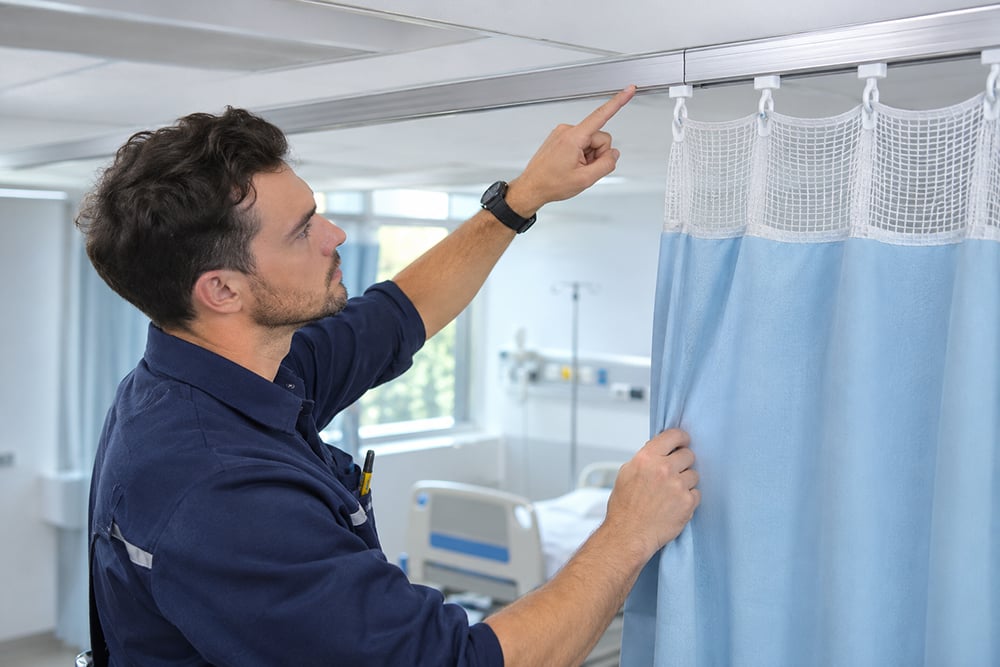
A hospital privacy curtain should open and close with controlled, predictable movement. When it becomes difficult to pull, staff may need several attempts to close a bed space or leave the curtain partly open.
The problem is not always the curtain fabric. Resistance can come from incompatible carriers, misaligned track joints, damaged components or a curtain that catches on nearby objects.
Hospital privacy curtains commonly drag or jam because the curtain, hooks, carriers and track do not work correctly as a complete system. The most useful first step is to identify whether resistance occurs along the whole track, at one location or only when the curtain is attached.
For hospital buyers and distributors, understanding that distinction helps prevent unnecessary curtain replacement and repeat ordering problems.
1. Separate Track Resistance From Fabric Drag
“Dragging” can describe two different faults.
The carriers may resist movement inside the track, or the fabric may catch on the floor, furniture or equipment. Both make the curtain harder to pull, but they require different checks.
Observe the curtain during normal opening and closing. Note where movement becomes difficult and whether the fabric touches anything.
If an authorized maintenance person can safely assess the carriers without the curtain attached, that comparison may help locate the fault:
- Resistance without the curtain suggests a track or carrier issue.
- Resistance mainly under curtain load suggests checking weight, attachments and alignment.
- Free carrier movement with fabric catching below suggests a clearance problem.
These observations guide inspection; they do not replace the track manufacturer’s maintenance procedure.
2. Check Carrier and Track Compatibility
Carriers that look similar are not necessarily interchangeable.
Their dimensions, wheel or sliding profile and connection to the curtain must suit the track. A component may enter the channel yet bind during movement, particularly around bends.
Manufacturer specifications illustrate why compatibility should be explicit. For example, Inpro identifies particular track systems compatible with its spool carrier rather than describing it as a universal component. Inpro Corporation
Before ordering replacement hospital curtains or hardware, record the track manufacturer and model where available. Request an approved carrier reference or physical sample.
Also distinguish the carrier from the curtain hook. The carrier travels inside the track; the hook or connector attaches the fabric to it. Either connection can create a mismatch.
3. Inspect Joints and Changes in Direction
A curtain that stops repeatedly at the same point deserves a location-specific inspection.
Possible causes include an uneven joint, a gap between track sections, a distorted channel or a connector that has moved out of alignment. A carrier may travel freely on straight sections but catch where two sections meet.
Track systems can use dedicated splices to connect straight lengths and bends. Inpro’s selection guidance, for example, identifies splice requirements for relevant track configurations. The correct arrangement is system-specific. inprocorp.com
Record the exact stopping point and whether it occurs in both directions. Give maintenance staff photographs and the track identification.
Do not force the curtain past an obstruction or attempt to reshape the channel without an approved repair method.
4. Look for Damaged or Worn Carriers
A single damaged carrier can interrupt the movement of an otherwise serviceable curtain.
Check for cracked components, distorted connectors, missing wheels where applicable and carriers that twist instead of travelling correctly.
Uneven hanging can provide a clue. If one section drops lower or pulls at an angle, inspect that attachment and its neighbouring components.
Replacement should follow the manufacturer’s instructions. Some systems include removable end caps or designated carrier-replacement arrangements; these features differ between models. Inpro Corporation
Replacing only the fabric will not resolve a damaged carrier inside the track.
5. Review Curtain Weight and Attachment Spacing
The curtain’s load includes more than its fabric weight per square metre. Finished width, height, mesh, reinforcement and accessories all contribute.
A replacement curtain may be heavier than the original even when the product photograph looks similar.
Check the track’s approved loading requirements and the specified carrier arrangement. Missing attachments or unsuitable spacing can concentrate load and leave sections hanging unevenly.
Avoid assuming that more carriers will always improve movement. The required number and spacing should follow the system and curtain design.
For OEM orders, identify the finished curtain weight, attachment positions and approved suspension components before production.
6. Check Width and Stacking Space
A curtain must provide enough coverage when closed and fit the available stacking space when open.
Excess fabric can create a bulky stack near the track end or a bend. Hooks, folds or adjoining panels may interfere as the curtain gathers.
Insufficient width creates a different problem: staff may pull harder in an attempt to close a gap that the curtain cannot cover.
Compare the proposed finished width with the track layout, required gathering and overlap. Do not assume curtain width should equal track length.
During sample approval, test both full closure and full opening. A curtain that moves acceptably halfway along the track may still jam when gathered.
7. Measure Installed Drop and Floor Clearance
Fabric touching the floor can make a compatible track system feel difficult to operate.
Calculate the installed drop from the actual suspension point. Include the carrier, hook or extension arrangement rather than using ceiling height alone.
Check clearance around the complete route, particularly where floor levels vary or the curtain passes furniture.
A change in hook length can alter clearance even when the replacement curtain has the same nominal height.
For hospital privacy curtains, approve a drawing showing the measurement reference points, total finished drop and intended floor clearance. Confirm these dimensions on an installed sample.
8. Inspect Track Fixings and Alignment
Loose supports, sagging sections or distorted installation can change the path through which carriers travel.
Manufacturer specifications commonly require tracks to be securely installed and aligned. Inpro’s Optitrac specification, for example, calls for a secure, rigid installation true to the ceiling line. inprocorp.com
If the track visibly moves during operation, stop pulling and refer it to facilities maintenance.
Do not compensate for movement by fitting improvised hooks, tightening unrelated components or increasing pulling force. The installation needs assessment against the approved system instructions.
9. Follow the Approved Cleaning and Maintenance Method
Debris or residue in the running channel may contribute to poor movement. However, the appropriate cleaning method depends on the track and carrier materials.
Do not apply general-purpose oil or lubricant simply because the curtain feels stiff. Some systems may not require lubrication, and an unsuitable product may leave residue or affect components.
Use the manufacturer’s cleaning, inspection and maintenance instructions. Report recurring resistance rather than repeatedly treating the symptom.
After maintenance, check the full route with the intended curtain attached.
A Practical Troubleshooting Table
| Observed problem | Items to investigate |
|---|---|
| Resistance along most of the route | Carrier compatibility, general condition and curtain load |
| Stopping at one fixed point | Joint alignment, local damage or obstruction |
| Difficulty mainly around bends | Carrier suitability, bend condition and hanging alignment |
| Jamming near the open position | Stacking space, excess fabric or attachment interference |
| Fabric pulling against the floor | Finished drop, connector length and floor clearance |
| One section hanging unevenly | Missing, damaged or twisted attachments |
| Track moving during operation | Fixings, supports and installation integrity |
These are inspection priorities, not confirmed diagnoses.
Prevent Problems Before Bulk Ordering
A useful approval trial tests the complete system: curtain, attachments, carriers and existing track.
Open and close a production-representative sample through the full route. Include bends, joints, overlaps and the stacked position.
For ESUN OEM/ODM enquiries, buyers can provide track photographs, hardware samples, room measurements and finished-curtain requirements. Keep the approved dimensions and attachment references in the order specification.
This makes repeat supply more reliable than approving fabric and colour alone.
Frequently Asked Questions
Will a lighter curtain solve track jamming?
Not necessarily. It will not correct an incompatible carrier, damaged joint or loose installation. Identify the cause first.
Are hospital curtain hooks universal?
No. Confirm the connection to both the curtain and the installed carrier system.
Should staff pull harder when the curtain sticks?
No. Stop and report persistent resistance so the cause can be assessed without damaging the system.
Can a curtain move freely but still fit incorrectly?
Yes. It may have insufficient privacy coverage, unsuitable floor clearance or inadequate stacking space.
What should buyers test before ordering?
Test an installation-ready sample along the entire track, including opening, closure, bends and gathering.