 EN
EN

Disposable Microfiber Mop Pad GSM Explained: Does Higher GSM Mean Better Cleaning?
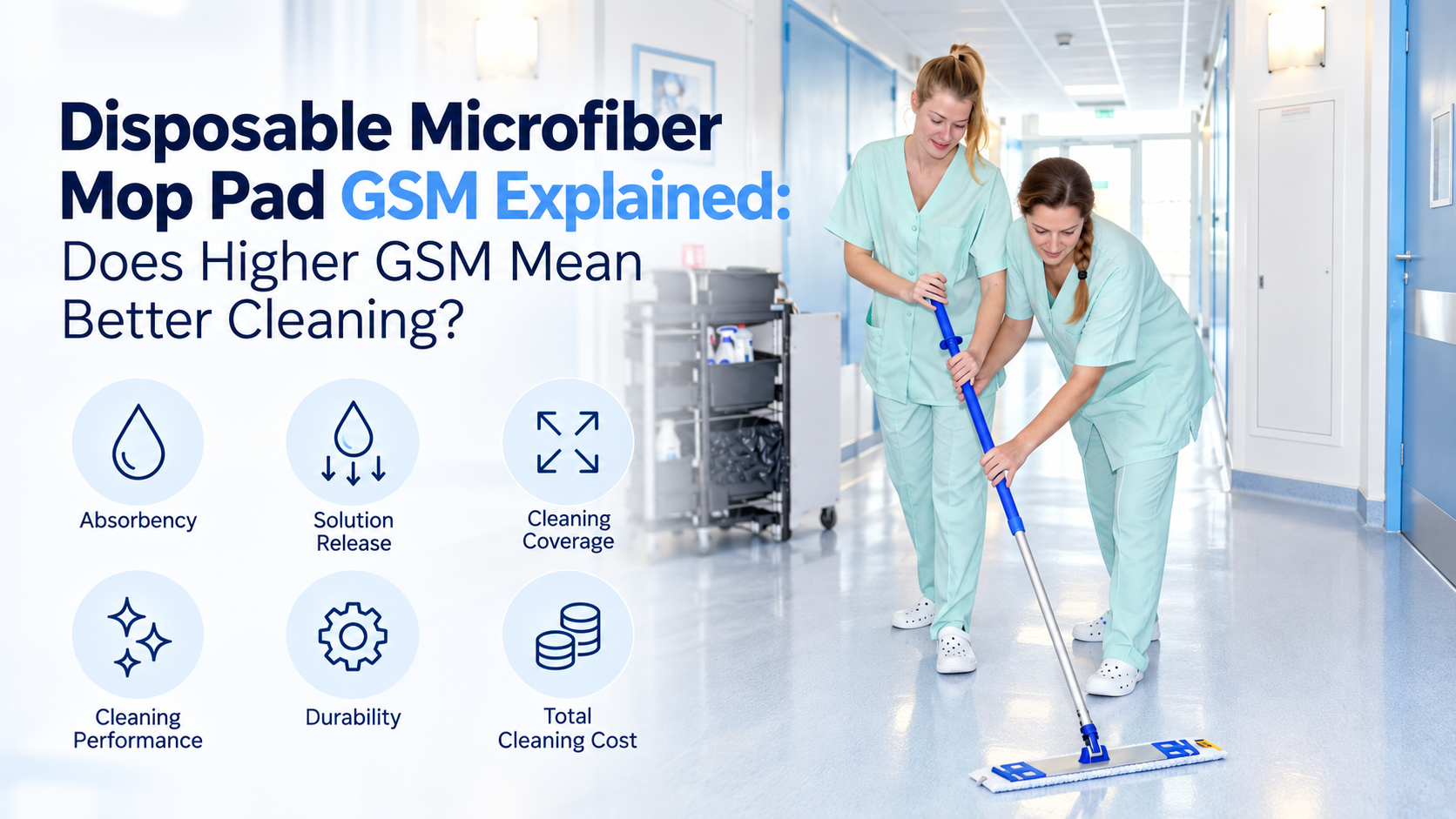
When sourcing a disposable microfiber mop pad, GSM is often one of the first numbers buyers compare.
240 GSM.
280 GSM.
300 GSM.
At first glance, the logic seems simple:
Higher GSM = more microfiber = better cleaning.
But in professional healthcare cleaning, that is not always true.
A heavier mop pad may absorb more liquid or feel more substantial, but GSM alone tells you very little about how efficiently the pad actually cleans a hospital floor.
For hospital procurement teams, healthcare cleaning distributors and OEM buyers, a better evaluation should include:
GSM + microfiber structure + absorbency + solution release + floor coverage + surface contact + chemical compatibility.
So what does GSM really mean, and how much should it influence your purchasing decision?
Short Answer: Does Higher GSM Mean Better Cleaning?
No. Higher GSM does not automatically mean better cleaning performance.
GSM tells you the weight of fabric per square meter.
It can influence:
-
Thickness
-
Liquid capacity
-
Fabric density
-
Durability
-
Manufacturing cost
But GSM does not directly tell you:
-
How effectively the fibers pick up soil
-
How much cleaning solution is released
-
How evenly the floor is wetted
-
How much floor area one pad can clean
-
How easily the mop moves across the floor
-
How much liquid remains trapped after use
A well-engineered 240–280 GSM microfiber structure may outperform a heavier pad if its fiber construction and liquid-management performance are better.
That is why professional buyers should avoid choosing disposable mop pads based on GSM alone.
What Does GSM Mean in a Microfiber Mop Pad?
GSM means:
Grams per Square Meter
It measures the weight of one square meter of fabric.
For example:
A 280 GSM microfiber fabric weighs approximately 280 grams per square meter.
This does not mean that one mop pad weighs 280 grams.
This distinction is important.
A finished disposable mop pad may only weigh a fraction of that amount because its actual dimensions are much smaller than one square meter.
When comparing supplier specifications, buyers should therefore clarify whether a number refers to:
Fabric GSM
or
Finished mop pad weight per piece
These two numbers are often confused in quotations and specification sheets.
Why Do Buyers Focus So Much on GSM?
GSM is easy to understand and easy to compare.
If Supplier A offers 240 GSM and Supplier B offers 300 GSM, the 300 GSM product may appear to be higher quality.
But microfiber cleaning products are more complicated than ordinary fabric.
Two mop pads with the same GSM can behave completely differently.
Why?
Because their fiber and fabric structures may not be the same.
Differences may include:
-
Fiber fineness
-
Polyester/polyamide ratio
-
Split-fiber quality
-
Loop structure
-
Pile height
-
Fabric density
-
Scrubbing yarn
-
Backing material
-
Absorbent inner layer
-
Edge construction
GSM tells you how much material is present.
It does not tell you how effectively that material is being used.
What Does Higher GSM Actually Change?
Higher GSM can affect several characteristics of a disposable microfiber mop pad.
1. Absorbency
In many cases, a heavier microfiber structure can hold more cleaning solution.
More fibers generally provide more surface area and more spaces for liquid retention.
However, there is an important distinction between:
holding more liquid
and
using that liquid effectively.
A mop pad that absorbs 500 ml but keeps a large percentage trapped inside the pad may not necessarily provide better floor coverage than a lighter pad with more efficient solution release.
For hospital cleaning, absorption should always be evaluated together with release performance.
2. Thickness
Higher-GSM fabrics often feel thicker.
This can provide:
-
Better cushioning
-
More liquid capacity
-
A more substantial product feel
But excessive thickness can sometimes create disadvantages.
A very thick pad may:
-
Require more cleaning solution
-
Increase packaging volume
-
Increase shipping cost
-
Create more drag during mopping
-
Retain more unused solution
Again, the right answer is balance rather than simply “more is better.”
3. Mop-to-Floor Contact
Cleaning performance depends heavily on how well the microfiber surface contacts the floor.
If a mop pad is too bulky or uneven, pressure may not be distributed consistently.
A well-designed pad should maintain stable surface contact while the cleaner moves the mop forward, backward and around furniture.
For professional cleaning, consistent contact can matter more than fabric weight alone.
4. Solution Consumption
This is particularly important for hospitals using pre-impregnated mop systems.
If a heavier pad requires more solution before it becomes properly saturated, chemical consumption may increase.
Consider two simplified examples.
Mop Pad A
Higher GSM
High absorption
Requires more solution
Retains a large amount after cleaning
Mop Pad B
Moderate GSM
Controlled absorption
High solution release
Provides even floor coverage
For a hospital cleaning program, Mop Pad B may be more efficient even though its GSM is lower.
5. Cleaning Resistance
Higher GSM can sometimes increase friction between the mop and floor.
Some friction is useful because microfiber needs contact with the surface to remove soil.
Too much resistance, however, can increase operator fatigue.
This matters in large healthcare facilities where environmental services staff may clean thousands of square meters every day.
Buyers should therefore evaluate:
Cleaning effectiveness + ergonomic resistance
rather than simply trying to maximize fabric thickness.
GSM vs Absorbency: Are They the Same?
No.
This is one of the most common misunderstandings in microfiber purchasing.
GSM measures fabric weight.
Absorbency measures liquid-holding capability.
They can be related, but they are not interchangeable.
A lower-GSM microfiber structure with efficient fibers may sometimes absorb surprisingly well.
Likewise, a heavy material may contain construction elements that add weight without proportionally increasing useful liquid capacity.
When asking suppliers about absorbency, request measurable information rather than assuming it from GSM.
Useful specifications include:
-
Liquid absorption per pad
-
Absorption as a percentage of product weight
-
Pre-saturation volume
-
Residual liquid after cleaning
GSM vs Solution Release
For healthcare cleaning, this comparison may be even more important.
Solution release measures how efficiently the mop transfers absorbed cleaning liquid back onto the floor.
Imagine a mop pad absorbs 400 ml of disinfectant.
If only 300 ml is effectively released during cleaning, a considerable amount remains inside the used pad.
Another pad may absorb a similar amount but release a much higher proportion.
For hospitals, that can influence:
-
Floor coverage
-
Chemical consumption
-
Cleaning consistency
-
Cost per cleaned square meter
For example, selected E-SUN disposable microfiber pocket mop pads use a 280 GSM microfiber structure and have achieved more than 94% solution release in internal product testing.
The important specification is not the 280 GSM number by itself.
It is the combination of:
280 GSM + microfiber structure + high solution release + approximately 22–23 m² cleaning coverage under suitable test conditions.
That provides buyers with much more useful information than GSM alone.
GSM vs Cleaning Coverage
Professional buyers often ask:
How many square meters can one disposable mop pad clean?
This is a much more practical question.
Coverage depends on:
-
Mop pad design
-
Pre-saturation volume
-
Solution release
-
Floor material
-
Soil level
-
Mop pressure
-
Cleaning protocol
Higher GSM does not guarantee larger coverage.
A very absorbent pad may actually hold more liquid inside the mop rather than distributing it across the floor.
For healthcare applications, some disposable microfiber mop pads are designed to cover approximately 20–25 m² per pad, depending on the cleaning system.
Buyers should therefore compare:
GSM → Liquid Capacity → Release Rate → Actual Coverage
instead of stopping at GSM.
Does Higher GSM Remove More Bacteria?
Not necessarily.
Microbial removal is influenced primarily by:
-
Fiber structure
-
Fiber splitting
-
Surface contact
-
Cleaning technique
-
Moisture level
-
Cleaning chemistry
-
Mop replacement protocol
Adding more material does not automatically create better microbial removal.
If a manufacturer claims that a specific mop pad removes a defined percentage of microorganisms, buyers should ask for supporting test information.
Questions should include:
-
Which microorganism was tested?
-
What test method was used?
-
Was water or disinfectant used?
-
Was the test performed on the finished mop pad?
-
What surface was tested?
For healthcare buyers, verified performance matters more than GSM marketing.
Is a 300 GSM Mop Better Than a 240 GSM Mop?
Not necessarily.
Imagine two disposable microfiber mop pads.
Pad A: 300 GSM
Thicker fabric
High liquid retention
Moderate solution release
Higher mopping resistance
Pad B: 240 GSM
Optimized microfiber construction
Controlled absorbency
Higher solution release
Better glide
Depending on the hospital's cleaning system, Pad B could provide better overall cleaning efficiency.
On the other hand, if the application requires high liquid capacity or extended wet cleaning, Pad A may be preferable.
There is no universal GSM winner.
The application decides.
What GSM Should Hospitals Choose?
There is no single GSM specification suitable for every healthcare application.
Instead, buyers should start with the cleaning environment.
General Patient Rooms
A balanced microfiber structure is usually more important than maximum GSM.
Priorities include:
-
Good soil pickup
-
Controlled solution release
-
Easy handling
-
One-room cleaning coverage
Isolation Rooms
Single-use protocols and contamination control may be more important than fabric weight.
The mop should provide reliable cleaning while supporting frequent pad changes.
Corridors and Larger Areas
Coverage and ergonomic performance become more important.
A pad that is too heavy when saturated may create unnecessary operator fatigue.
High-Soil Areas
More aggressive microfiber or integrated scrubbing stripes may be more useful than simply increasing GSM.
Cleanrooms
GSM becomes only one small part of the specification.
Cleanroom buyers may need to consider:
-
Particle generation
-
Fiber shedding
-
APC requirements
-
Material compatibility
-
Packaging
-
Sterilization requirements
What About Scrubbing Stripes?
This is another example of why GSM can be misleading.
A disposable microfiber mop pad may incorporate:
-
PP scrubbing stripes
-
Polyester scrubbing fibers
-
Abrasive yarn
-
Different surface patterns
These features can increase mechanical cleaning action without dramatically increasing overall GSM.
For dried contamination or heavier soil, the mop surface design may therefore matter more than adding extra microfiber weight.
Professional buyers should ask:
How is the mop designed to remove adhered soil?
not only:
How many GSM is it?
Does Higher GSM Mean Better Durability?
Often, but not automatically.
More material can increase strength, but durability also depends on:
-
Fiber quality
-
Knitting quality
-
Lamination
-
Stitching
-
Ultrasonic bonding
-
Pocket construction
-
Backing material
For a single-use healthcare mop pad, extreme durability may not even be the main objective.
The pad needs to remain stable for its defined cleaning task.
Making a disposable mop unnecessarily heavy simply to increase durability can increase material and logistics costs without adding practical value.
How Does GSM Affect Shipping and Packaging?
This is especially important for distributors and OEM buyers purchasing hundreds of thousands of mop pads.
Higher GSM usually means:
-
More raw material
-
More product weight
-
Potentially greater carton weight
-
Increased logistics cost
Thickness also affects carton volume.
This is why compression packaging is frequently used for disposable microfiber mop pads.
However, aggressive compression can affect product recovery.
Buyers should ask:
-
How much compression is used?
-
Does the pad recover its original thickness?
-
Does compression change absorption?
-
Does it affect solution release?
A lower-cost shipping method is not useful if it damages cleaning performance.
How Should Healthcare Distributors Compare Mop Pads?
A good supplier comparison should not look like this:
| Supplier | GSM | Price |
|---|---|---|
| A | 240 | — |
| B | 280 | — |
| C | 300 | — |
This provides too little information.
A more useful comparison is:
| Specification | Why It Matters |
|---|---|
| GSM | Fabric weight |
| Material Composition | Fiber performance |
| Mop Weight | Finished-product consistency |
| Absorption | Liquid capacity |
| Solution Release | Liquid utilization |
| Cleaning Coverage | Operational efficiency |
| Microbial Removal | Cleaning performance |
| Scrubbing Structure | Soil removal |
| Chemical Compatibility | Hospital disinfectant use |
| Frame Compatibility | Practical usability |
| Compression Recovery | Transport and storage |
| Packaging Quantity | Logistics cost |
This gives buyers a more realistic picture of total product performance.
What Should OEM Buyers Specify?
OEM customers should avoid sending suppliers only:
“We need a 280 GSM disposable mop.”
Instead, provide the intended performance target.
For example:
-
Mop dimensions
-
Mop frame size
-
Pocket or Velcro attachment
-
Target GSM
-
Required absorbency
-
Pre-saturation volume
-
Desired cleaning coverage
-
Solution release target
-
Scrubbing requirement
-
Chemical compatibility
-
Edge color
-
Packaging quantity
-
Compression requirement
A manufacturer can then adjust the microfiber construction according to the actual cleaning application.
This produces a better OEM product than simply copying a competitor's GSM.
GSM and Total Cleaning Cost
For professional buyers, cost per piece is only one part of the calculation.
A more useful metric is:
Cost per Cleaned Square Meter
For example, imagine:
Mop Pad A costs less per piece but cleans a smaller area.
Mop Pad B costs slightly more but provides greater coverage and better chemical utilization.
The more expensive unit may actually have the lower operating cost.
Procurement teams should therefore consider:
Mop Cost + Chemical Consumption + Labor + Coverage + Disposal
This is particularly important for hospitals using large numbers of disposable mop pads every month.
7 Questions Buyers Should Ask Before Choosing GSM
Before approving a disposable microfiber mop pad, ask the supplier:
1. Is the number GSM or finished pad weight?
Do not confuse the two.
2. How much liquid can one pad absorb?
Request a measurable value.
3. What is the solution release rate?
This tells you how effectively the liquid is used.
4. How many square meters can one pad clean?
Ask for the test conditions as well.
5. Is the mop compatible with hospital disinfectants?
Check compatibility with the chemicals used by your customers.
6. Does compression packaging change performance?
Verify thickness recovery and absorbency after unpacking.
7. What performance testing is available?
Ask for supporting test reports when microbial-removal claims are made.
Frequently Asked Questions
What does GSM mean in a disposable microfiber mop pad?
GSM means grams per square meter. It measures the weight of the mop fabric rather than the total weight of one finished mop pad.
Is higher GSM better for microfiber mop pads?
Not necessarily. Higher GSM may increase thickness and absorption, but cleaning performance also depends on microfiber structure, solution release, surface contact and mop design.
Is a 280 GSM microfiber mop pad good for hospital cleaning?
A 280 GSM structure can work well for healthcare cleaning when it is combined with suitable absorption, solution release, surface contact and chemical compatibility. GSM should not be evaluated alone.
Does higher GSM mean higher absorbency?
Often there is a relationship, but not always. Fiber construction and fabric structure also strongly influence absorption.
Does higher GSM remove more bacteria?
Not automatically. Microbial removal depends on microfiber structure, cleaning method, moisture, surface contact and other factors.
What GSM should I choose for hospital mop pads?
There is no universal GSM. Buyers should select the specification according to the cleaning area, required absorption, solution release, coverage and cleaning protocol.
What is more important than GSM?
For professional hospital cleaning, solution release, cleaning coverage, fiber structure, chemical compatibility and verified cleaning performance can be more useful purchasing indicators.
Final Recommendation for Professional Buyers
GSM is useful.
But it should be treated as one specification, not a quality score.
A higher-GSM disposable microfiber mop pad may provide greater thickness or liquid capacity, but it does not automatically provide better cleaning.
For hospitals and healthcare distributors, the better purchasing formula is:
GSM + Fiber Structure + Absorption + Solution Release + Cleaning Coverage + Chemical Compatibility + Ergonomics
If two suppliers offer different GSM values, do not immediately choose the heavier product.
Ask which mop delivers the required cleaning performance with the most efficient use of solution, labor and consumables.
For OEM projects, the best mop pad is not necessarily the one with the highest GSM.
It is the one engineered around the customer's cleaning system.
E-SUN provides customizable disposable microfiber mop pads for hospitals, healthcare cleaning distributors and OEM customers, with options including different microfiber structures, GSM specifications, pocket and hook-and-loop attachment, scrubbing stripes, color-coded edges, compression packaging and private-label solutions.