 EN
EN

NFPA 701 vs BS 5867: What Hospital Curtain Buyers Should Know
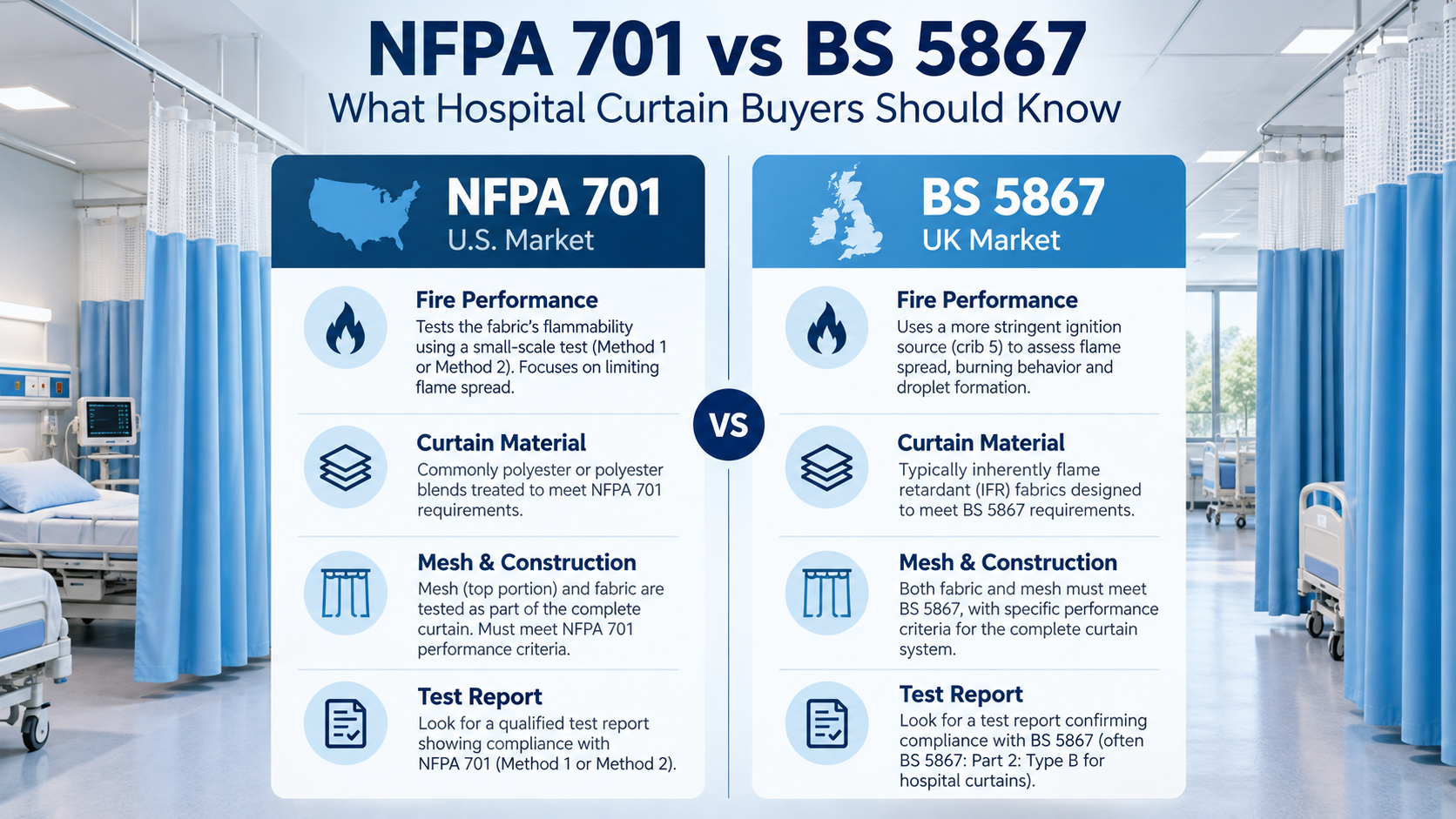
When purchasing hospital privacy curtains, fire performance is one specification that should never be treated as a simple checkbox.
Two standards buyers frequently encounter are:
NFPA 701
and
BS 5867
Both relate to the fire performance of curtain materials, but they are different standards developed for different markets and testing systems.
For hospital procurement teams, healthcare distributors and OEM buyers, the most important rule is simple:
Do not assume a curtain that passes NFPA 701 automatically complies with BS 5867 — or vice versa.
The required standard should be confirmed according to the destination market, hospital tender and local fire-safety requirements.
Quick Answer: NFPA 701 vs BS 5867
NFPA 701 is a U.S. standard used to evaluate flame propagation of textiles and films, including hanging materials such as curtains. NFPA documentation specifically references its use for draperies and curtains, including materials used in healthcare occupancies.
BS 5867-2:2008 is a British standard covering flammability requirements for fabrics and fabric assemblies used for non-domestic curtains, drapes and window blinds. It remains listed as current by BSI.
For UK healthcare procurement, NHS Supply Chain currently states that curtains on its framework have passed BS 5867-2:2008 Type B or Type C requirements.
What Is NFPA 701?
NFPA 701 is titled:
Standard Methods of Fire Tests for Flame Propagation of Textiles and Films.
It evaluates how certain textile and film materials respond when exposed to flame.
For hospital curtain buyers, NFPA 701 may appear in specifications for:
-
Hospital privacy curtains
-
Cubicle curtains
-
Window curtains
-
Hanging textiles
-
Other interior fabric applications
NFPA materials also note that fabrics meeting NFPA 701 test requirements are commonly used in hospitals, hotels and similar occupancies.
If you are supplying a hospital project in the United States, NFPA 701 is therefore an important standard to check when it appears in the project specification.
However, passing NFPA 701 does not automatically mean the curtain meets every local building or fire-code requirement.
Always verify the hospital's tender and local authority requirements.
What Is BS 5867?
BS 5867 is a British standard series covering curtain and drapery fabrics.
For fire performance, buyers usually refer to:
BS 5867-2:2008 — Fabrics for curtains, drapes and window blinds — Flammability requirements.
BSI states that this part applies to fabrics and fabric assemblies intended for non-domestic curtains, drapes and blinds.
This makes it particularly relevant for institutional applications such as:
-
Hospitals
-
Care facilities
-
Hotels
-
Public buildings
-
Commercial interiors
UK government fire-safety guidance also identifies BS 5867-2 as the relevant standard for the flammability of curtain and drapery fabrics.
NFPA 701 vs BS 5867: Key Differences
| Factor | NFPA 701 | BS 5867-2 |
|---|---|---|
| Common Market | United States | United Kingdom |
| Main Focus | Flame propagation of textiles and films | Flammability of non-domestic curtain fabrics |
| Typical Products | Curtains, drapes, hanging textiles | Curtains, drapes, blinds |
| Healthcare Use | Frequently referenced | Frequently referenced |
| Result System | Based on NFPA test-method criteria | Uses BS 5867 performance classifications |
| Automatic Equivalence | No | No |
The key purchasing point is:
These standards should not be treated as interchangeable certificates.
A supplier should test the actual curtain material according to the standard required for the destination project.
Which Standard Should Hospital Buyers Choose?
A simple starting point is:
U.S. Hospital Projects
Check whether the tender or facility requires NFPA 701.
NFPA fire and life-safety documentation references NFPA 701 criteria for draperies, curtains and similar hanging materials in healthcare occupancies.
UK Hospital Projects
Check whether the project specifies BS 5867-2:2008, including the required performance type.
NHS Supply Chain currently lists hospital curtains meeting Type B or Type C requirements within its curtain framework.
European or Other Markets
Do not automatically specify either standard.
Different countries may require other national or European fire-performance standards.
The safest approach is always:
Target Market → Tender Requirement → Required Test Standard → Supplier Test Report
What Should Buyers Check on a Fire-Test Report?
Do not accept only a product description saying:
“Fire Retardant Hospital Curtain.”
Ask for supporting documentation.
Check:
1. Exact Standard
The report should clearly state whether the product was tested to:
NFPA 701
or
BS 5867-2
rather than simply saying “FR tested.”
2. Material Description
Confirm that the tested material matches the curtain you are purchasing.
For example:
-
PP nonwoven
-
SMS / SMMS
-
Polyester
-
Curtain with mesh
-
Printed or treated fabric
3. Fabric Weight or Construction
If your order uses a different GSM, coating or structure from the tested sample, ask whether the existing report still applies.
4. Finished Construction
BSI notes that where curtains use multi-layer constructions, the materials should be evaluated in the combination in which they are intended to be used.
This is particularly important for curtains with:
-
Linings
-
Multiple layers
-
Different mesh sections
-
Special finishes
5. Durability After Cleaning
For reusable curtains, buyers should ask whether fire-retardant performance is maintained after the required washing or cleaning process.
UK government fire-safety guidance warns that some flame-retardant treatments can have a limited wash life and recommends following the supplier's instructions.
Inherently FR vs FR-Treated Curtains
Hospital curtains may achieve fire performance in different ways.
Inherently Flame-Retardant Material
The flame-resistant properties are built into the fiber or material structure.
This can be useful for reusable curtains where repeated laundering is expected.
Flame-Retardant Treated Material
A treatment is applied to the textile to improve its fire performance.
For these products, buyers should ask:
-
How durable is the treatment?
-
Can the curtain be washed?
-
How many cleaning cycles are recommended?
-
Does the test report represent the finished product?
The answer matters especially for reusable polyester hospital curtains.
What About Disposable Hospital Curtains?
Disposable hospital privacy curtains made from PP or SMS/SMMS can also be manufactured to meet project-specific fire-performance requirements.
For disposable products, buyers should confirm:
-
Material and GSM
-
Required fire standard
-
Curtain body construction
-
Mesh construction
-
Printing or color treatment
-
Whether the finished specification matches the tested sample
Changing the material after testing may affect compliance.
For OEM projects, fire-performance requirements should therefore be confirmed before mass production, not after the curtain design is finalized.
Common Purchasing Mistakes
One common mistake is assuming “fire retardant” equals certification. It does not. Buyers should ask which standard was tested and request supporting documentation.
Another mistake is using a U.S. NFPA 701 report for a UK tender requiring BS 5867, or assuming that a BS 5867 result automatically satisfies a U.S. specification.
Buyers should also avoid testing one material and then ordering a significantly different GSM, coating, mesh or fabric construction without confirming whether the report still applies.
FAQ
Is NFPA 701 the same as BS 5867?
No. They are separate fire-testing standards with different test systems and market applications.
Which fire standard is commonly used for U.S. hospital curtains?
NFPA 701 is commonly referenced for hanging textiles and curtains in U.S. projects, including healthcare applications.
Which standard is commonly used in UK hospital curtain procurement?
BS 5867-2:2008 is widely referenced. NHS Supply Chain currently specifies curtains meeting Type B or C requirements within its framework.
Can one test report cover every hospital market?
Usually not. Buyers should follow the specific standard required by the destination market and project tender.
Should reusable hospital curtains be tested after washing?
Buyers should verify durability after the required cleaning process, particularly where flame-retardant treatments are used.
Final Recommendation for Hospital Curtain Buyers
When sourcing fire-retardant hospital privacy curtains, do not begin with:
“Is this curtain fireproof?”
A better question is:
“Which fire standard has this exact curtain construction been tested to?”
For most B2B projects, check:
Destination Market → Required Standard → Material → Finished Construction → Test Report → Cleaning Durability
NFPA 701 and BS 5867 both play important roles in curtain fire safety, but they are not interchangeable.
For hospitals, healthcare distributors and OEM buyers, confirming the correct standard before production can prevent failed tenders, repeated testing and costly specification changes.
E-SUN provides customizable disposable and reusable hospital privacy curtains, including PP nonwoven, SMS/SMMS and polyester options, with project-specific material, size, mesh, printing, hook and fire-performance requirements available for OEM and healthcare procurement projects.