All Categories

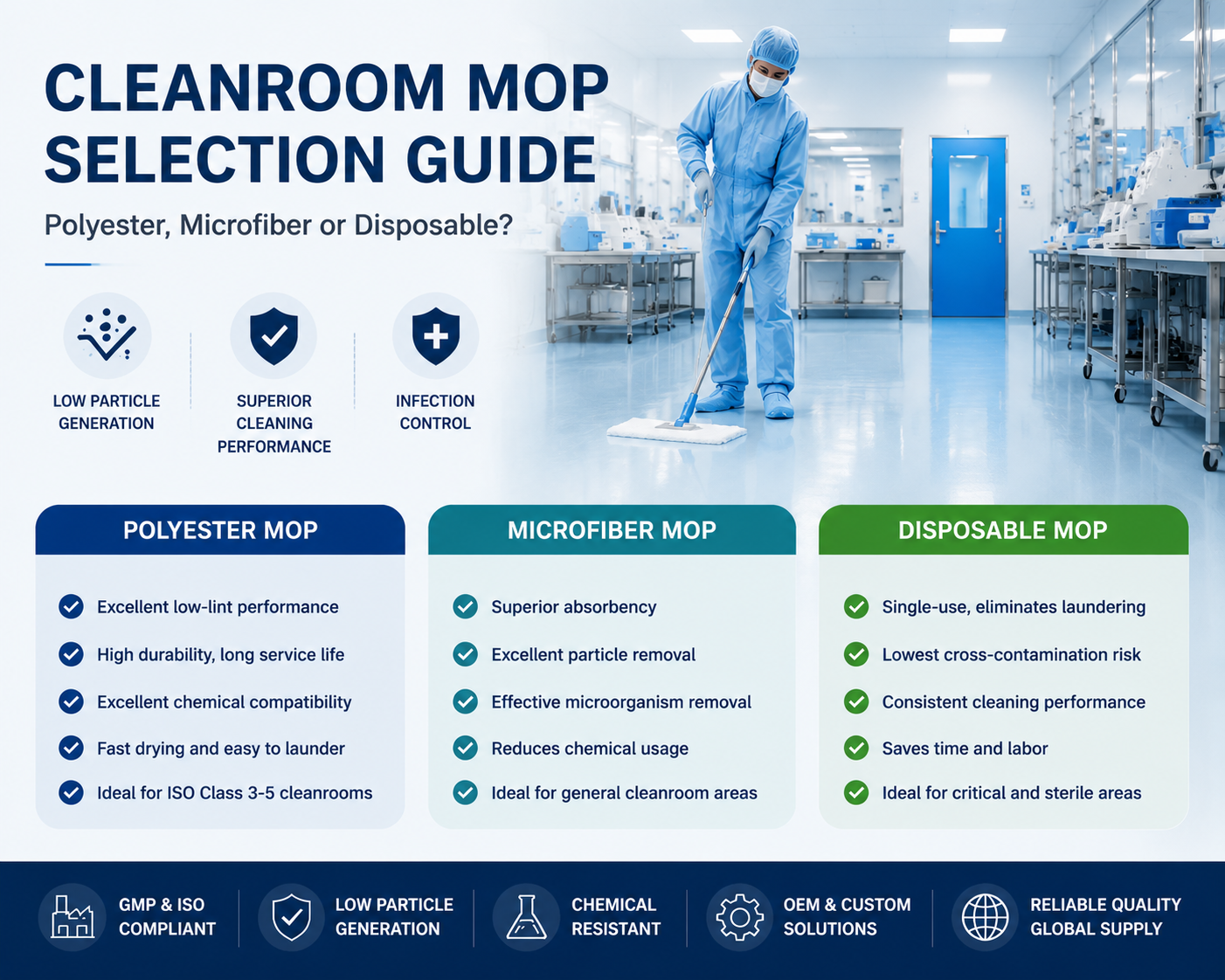
Cleanroom Mop Selection Guide: Polyester, Microfiber or Disposable?

Time : 2026-07-31

Choosing the right cleanroom mop is essential for maintaining contamination control in pharmaceutical manufacturing, biotechnology laboratories, semiconductor production, medical device facilities, and other controlled environments.

While many facilities focus on disinfectants and cleaning procedures, the mop itself plays a critical role in particle removal, chemical compatibility, and operational efficiency.

This guide compares polyester cleanroom mops, microfiber cleanroom mops, and disposable cleanroom mops to help facility managers, procurement teams, and cleanroom supply distributors select the most suitable solution.
cleanroom mop.png

Why Cleanroom Mop Selection Matters

Unlike standard commercial cleaning, cleanroom maintenance requires products that minimize contamination while effectively removing particles, residues, and microorganisms.

An unsuitable mop may:

  • Generate unwanted particles
  • Leave lint or fibers behind
  • Incompatibly react with disinfectants
  • Increase cross-contamination risks
  • Shorten cleaning efficiency
  • Raise operational costs

Selecting the appropriate mop material helps maintain compliance with cleanroom cleaning protocols while improving productivity.

Three Main Types of Cleanroom Mops

The three most commonly used cleanroom mop materials are:

  • Polyester
  • Microfiber
  • Disposable nonwoven or microfiber

Each serves different applications depending on the cleanroom classification, cleaning frequency, and contamination control requirements.

Polyester Cleanroom Mops

Best For

  • ISO Class 3–5 cleanrooms
  • GMP Grade A/B pharmaceutical areas
  • Semiconductor manufacturing
  • Precision electronics
  • Optics production

Advantages

Excellent Low Particle Generation

Polyester fibers produce extremely low levels of lint, making them suitable for critical cleanroom environments.

Strong Chemical Compatibility

Polyester withstands frequent exposure to:

  • IPA
  • Hydrogen peroxide
  • Quaternary ammonium disinfectants
  • Chlorine-based disinfectants

High Durability

High-quality polyester mops can tolerate repeated laundering while maintaining structural integrity.

Fast Drying

Low moisture retention helps reduce bacterial growth between cleaning cycles.

Considerations

Polyester mops generally provide lower absorbency than microfiber, making them better suited for controlled precision cleaning rather than heavy liquid removal.


Microfiber Cleanroom Mops

Best For

  • Pharmaceutical production
  • Medical device manufacturing
  • Hospital cleanrooms
  • Biotechnology laboratories
  • General ISO cleanrooms

Advantages

Superior Particle Removal

Ultra-fine fibers capture microscopic contaminants more effectively than traditional materials.

Excellent Absorbency

Microfiber absorbs significantly more liquid, making it ideal for disinfectant application and spill cleanup.

Effective Microorganism Removal

The dense fiber structure enhances the removal of bacteria and fine particles from smooth surfaces.

Reduced Chemical Consumption

Microfiber distributes cleaning solutions evenly, helping facilities reduce disinfectant usage.

Considerations

Microfiber requires appropriate laundering procedures to maintain cleaning performance over repeated use.


Disposable Cleanroom Mops

Best For

  • GMP Grade A/B areas
  • Sterile pharmaceutical production
  • Biotechnology facilities
  • Compounding pharmacies
  • Critical contamination control zones

Advantages

Eliminates Laundering Risks

Each mop is used once and discarded, eliminating contamination introduced during washing or transportation.

Consistent Cleaning Quality

Every cleaning task begins with a new mop, providing predictable performance.

Lower Cross-Contamination Risk

Disposable systems reduce the transfer of contaminants between production areas.

Simplified Inventory Management

Facilities no longer need to manage washing schedules or repair reusable mops.

Considerations

Disposable mops typically have a higher per-unit purchase cost, but many facilities offset this through savings in laundry, labor, water, energy, and quality control.


Polyester vs Microfiber vs Disposable Cleanroom Mops

Feature Polyester Microfiber Disposable
Low Particle Generation Excellent Excellent Excellent
Absorbency Good Excellent Good to Excellent
Durability Excellent Very Good Single Use
Cross-Contamination Risk Low Low Lowest
Laundering Required Yes Yes No
Chemical Compatibility Excellent Excellent Product Dependent
GMP Applications Excellent Excellent Excellent
High-Risk Areas Good Very Good Best

Which Cleanroom Mop Is Right for Your Industry?

Pharmaceutical Manufacturing

Recommended:

  • Polyester cleanroom mops for critical production areas
  • Disposable cleanroom mops for sterile environments
  • Microfiber mops for support zones

Semiconductor Manufacturing

Recommended:

High-density polyester cleanroom mops because of their exceptionally low particle generation.


Biotechnology Laboratories

Recommended:

Microfiber cleanroom mops for daily cleaning combined with disposable options for contamination-sensitive operations.


Medical Device Manufacturing

Recommended:

A combination of microfiber and polyester mops depending on process cleanliness requirements.


Hospital Cleanrooms

Recommended:

Disposable microfiber cleanroom mops for isolation rooms, sterile processing departments, and pharmacy cleanrooms to reduce cross-contamination and simplify infection control protocols.


Factors to Consider Before Choosing a Cleanroom Mop

When evaluating suppliers, procurement teams should assess more than price.

Important considerations include:

Material Composition

Choose polyester, microfiber, or disposable materials based on contamination control requirements.

Particle Performance

Verify low-lint and low-particle characteristics through testing data.

Chemical Compatibility

Ensure compatibility with commonly used disinfectants and cleaning agents.

Sterilization Options

Some cleanroom applications require gamma-sterilized or autoclave-compatible products.

Mop Design

Evaluate:

  • Pocket style
  • Hook-and-loop backing
  • Flat mop systems
  • Edge sealing technology
  • Ultrasonic welding

Manufacturing Quality

Look for manufacturers with consistent production processes, quality inspections, and experience serving pharmaceutical and electronics industries.


Why More Facilities Use Multiple Mop Types

Many modern cleanroom facilities no longer rely on a single mop type.

Instead, they combine products based on cleaning zones:

  • Polyester mops for critical ISO Class 3–5 areas where particle control is paramount.
  • Microfiber mops for routine cleaning in support and production zones, offering strong absorbency and excellent contaminant removal.
  • Disposable mops for sterile suites, aseptic filling areas, and locations where eliminating laundering risks is a priority.

This zone-based approach helps optimize contamination control while balancing operational costs.


How to Choose a Reliable Cleanroom Mop Manufacturer

For distributors, OEM brands, and industrial buyers, a supplier should provide more than standard products.

Key capabilities include:

  • Custom sizes and mop constructions
  • Low-lint manufacturing processes
  • Chemical compatibility validation
  • Stable production capacity
  • OEM and private-label services
  • Consistent quality control
  • Technical documentation and product traceability
  • International shipping experience

A manufacturing partner that understands cleanroom standards can help ensure product consistency across pharmaceutical, electronics, healthcare, and laboratory applications.


Conclusion

There is no universal cleanroom mop suitable for every controlled environment.

  • Polyester cleanroom mops excel in ultra-low particle generation and durability, making them ideal for critical cleanroom operations.
  • Microfiber cleanroom mops provide outstanding absorbency and particle removal for routine pharmaceutical, medical, and laboratory cleaning.
  • Disposable cleanroom mops offer the highest level of contamination control by eliminating laundering and reducing cross-contamination risks.

Selecting the right solution depends on your cleanroom classification, cleaning protocols, contamination risks, and operational objectives. For procurement teams and distributors, evaluating material performance, compliance, and supplier expertise is just as important as comparing purchase costs.


Frequently Asked Questions (FAQ)

What is the best mop material for pharmaceutical cleanrooms?

Polyester and disposable cleanroom mops are commonly used in critical pharmaceutical environments due to their low particle generation and compatibility with stringent contamination-control requirements.

Are microfiber mops suitable for cleanrooms?

Yes. High-quality cleanroom-grade microfiber mops provide excellent particle capture and absorbency, making them suitable for many ISO-classified cleanrooms when used according to validated cleaning procedures.

When should disposable cleanroom mops be used?

Disposable cleanroom mops are recommended for sterile manufacturing, aseptic processing, hospital pharmacy cleanrooms, and other areas where eliminating laundering-related contamination is a priority.

Can one facility use different types of cleanroom mops?

Yes. Many facilities adopt a zone-based strategy, using polyester, microfiber, and disposable mops in different cleanroom areas based on contamination risk and cleaning requirements. This approach improves efficiency while supporting compliance and cost control.

PREV : How to Select a Cleanroom Mop That Reduces Particle Contamination

NEXT : Disposable vs Reusable Hospital Curtains: Complete Buying Guide for Healthcare Facilities

Get a Free Quote

Our representative will contact you soon.
Email
Mobile
Name
Company Name
Message
0/1000