 EN

Compressed vs Standard Packaging for Microfiber Disposable Mop Pads: What Buyers Should Evaluate
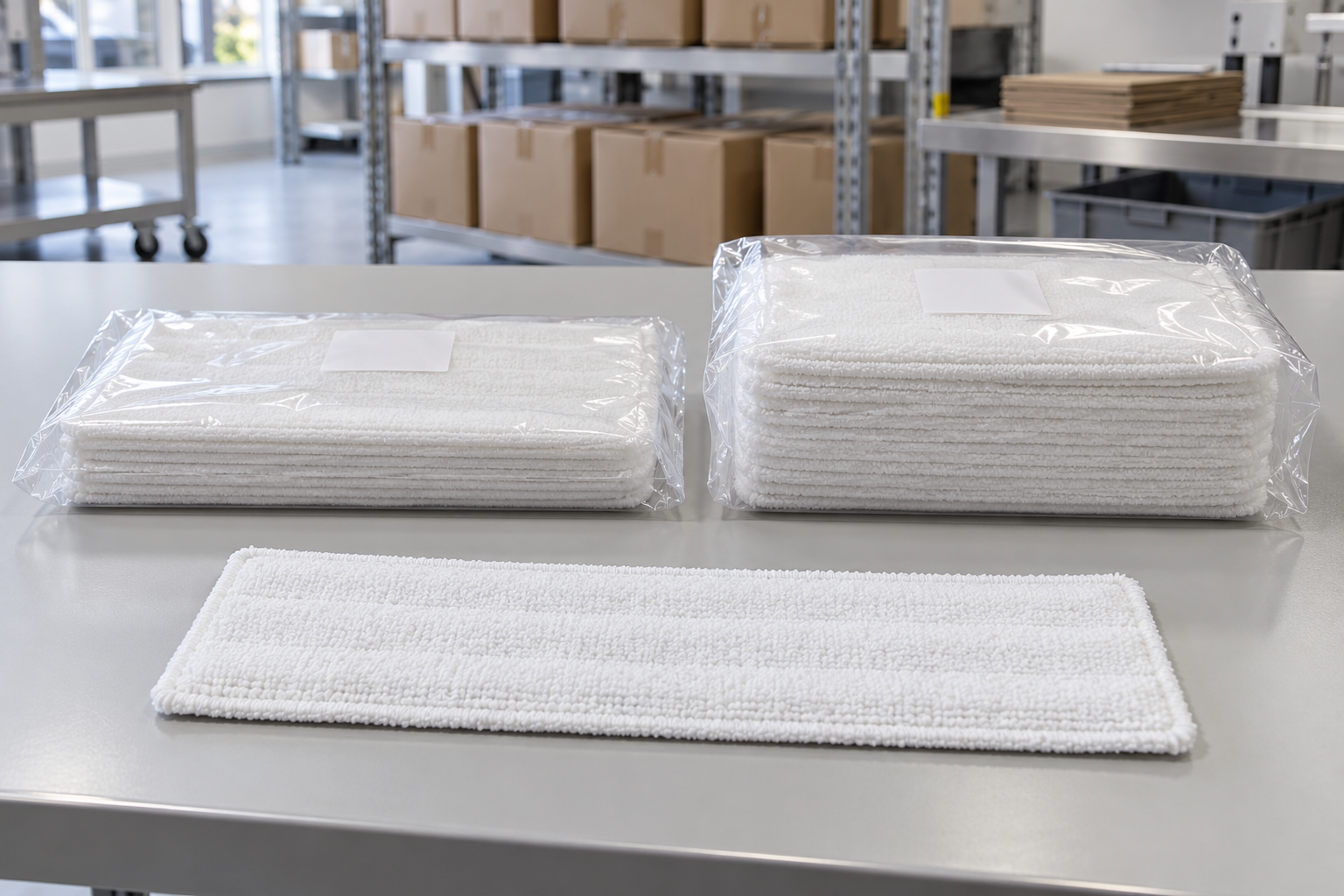
Packaging can make a noticeable difference to the cost of importing microfiber disposable mop pads. Products that are lightweight but bulky may occupy substantial container and warehouse space, making compressed packaging an attractive option.
However, a smaller package is only part of the purchasing decision. Buyers also need to know how the pads recover after opening, whether they remain easy to separate and whether their cleaning performance is consistent with the approved sample.
Compressed packaging is worth considering when verified space savings are achieved without compromising packaging integrity, product performance or handling efficiency. Standard packaging may be more practical where immediate use, smaller order quantities or simple dispensing are the main priorities.
Understand What the Supplier Means by “Compressed”
Compressed packaging reduces the space occupied by the mop pads through applied pressure, air removal or a combination of methods. The degree of compression can vary considerably between suppliers.
Vacuum packaging is one method of removing air from a sealed pack. Mechanical compression may also be used without maintaining a vacuum. Buyers should therefore avoid treating “compressed” and “vacuum packed” as interchangeable specifications.
Standard packaging generally means the pads are packed without a deliberate volume-reduction process, although ordinary stacking and carton packing can still compress them to some extent.
Ask the supplier to define the proposed arrangement: pieces per bag, bags per carton, compression method, final carton dimensions and any instructions for use after opening.
1. Compare Shipping Volume on an Equal Basis
A smaller inner bag does not necessarily produce an equivalent reduction in shipping volume. Carton dimensions, pallet arrangements and unused loading space also affect the result.
Compare both packaging options using the same product specification and order quantity. Request:
- Pieces per carton.
- Final external carton dimensions.
- Net and gross carton weight.
- Pallet configuration, where applicable.
- Estimated container loading quantity and its assumptions.
Calculate carton volume from the external dimensions:
Carton volume in m³ = length × width × height in metres.
Then divide by the number of pads to compare shipping volume per piece.
For example, if standard packaging occupies 0.060 m³ per 200 pads and compressed packaging occupies 0.045 m³ for the same quantity, the carton-volume reduction is 25%. This is an illustrative calculation, not a product performance claim.
Actual freight savings will depend on shipment size, charging method and loading constraints.
2. Check Pad Recovery After Opening
A freshly compressed sample may not represent stock that has spent several months in storage and transit.
Ask suppliers to provide samples packed under production conditions and held for an agreed period. Evaluate them immediately after opening and at any recovery interval the supplier recommends.
Check whether the pads:
- Return to usable dimensions and shape.
- Separate without excessive pulling.
- Lie flat on the mop frame.
- Retain functional pockets or attachment backing.
- Show persistent folds or uneven thickness.
Some visible flattening may be acceptable if the pad performs as required. Appearance alone should not determine acceptance.
Equally, a pad that looks fuller after opening has not necessarily recovered its original cleaning characteristics. Physical recovery and functional performance should be assessed separately.
3. Compare Cleaning Performance After Storage
The relevant question is whether the delivered pad still performs the assigned cleaning task.
Compare compressed and standard packs using the same flooring, frame, liquid preparation and cleaning procedure. Where possible, use pads from the same production batch to reduce unrelated variation.
Evaluate absorbency, wetting speed, solution release, wet strength and attachment security. Observe whether either option requires more preparation or repeated passes.
For pre-saturated cleaning systems, check how evenly the pads take up liquid within the intended preparation time. Do not assume that compression improves or reduces absorbency without supporting test results.
Agree on acceptance criteria before the trial. “No effect on quality” is too broad to serve as a purchasing specification.
4. Inspect the Complete Packaging System
Compression changes how the product and packaging interact. Buyers should inspect the bags, seals and cartons rather than focusing only on the compressed bundle.
Look for stretched film, punctures, stressed seals and carton distortion. Check whether tightly packed edges or attachment components press against the bag.
For vacuum-packed products, define how loss of vacuum will be assessed. An expanded pack may indicate a leak, but its acceptability depends on the packaging’s intended function and the agreed specification.
Transport testing should reflect the actual distribution route. ISTA advises selecting tests with an understanding of the packaged product’s distribution environment. A suitable test programme evaluates the product and packaging together. International Safe Transit Association
A successful transport test does not, by itself, establish cleaning performance, cleanliness or sterile status.
5. Consider Storage Before and After Opening
Compressed packaging may reduce space in the central warehouse. That benefit can change once the pack is opened.
If pads expand substantially, the receiving department needs enough clean storage space for the opened quantity. Large compressed bundles may be inconvenient where staff use only a few pads per shift.
Review the full storage sequence: receiving, warehouse shelving, internal distribution, opening and storage before use.
Ask for stated storage conditions and evidence supporting any shelf-life claim. Where packaging tests involve controlled conditioning, ISO 2233 addresses conditioning of complete, filled transport packages and unit loads for testing. It does not independently establish a mop pad’s shelf life. Conditioning for testing
6. Include Handling Time in the Cost Comparison
Standard packs may offer straightforward dispensing, while compressed packs may require time for opening, separation or recovery. These differences should be measured rather than assumed.
During a trial, record how long staff take to open each pack, prepare the pads and load them onto the cleaning system.
If cutting tools are needed, check whether operators can open the bag without damaging its contents. Confirm that labels and batch information remain available after the outer packaging is discarded.
Pack quantity also matters. A compact bulk pack may suit a distributor, while smaller inner packs may better match a hospital’s daily consumption.
7. Review Total Cost and Environmental Claims
Compare packaging formats using the cost per usable pad delivered and prepared for use.
Include product price, freight, warehouse space, handling, damaged stock and packaging disposal. Container loading capacity should also be checked against weight limits and practical loading arrangements.
Environmental claims need similar care. Reduced shipping volume may improve loading efficiency, but it does not automatically prove a lower overall carbon footprint.
Extra film, rejected products, repacking and changes in transport arrangements can affect the outcome. Claims such as “less packaging” or “lower emissions” should identify the comparison and supporting measurements.
For ESUN OEM/ODM enquiries, buyers can request standard and compressed packaging proposals for the same mop specification. Approving both the packing configuration and post-opening performance provides a clearer basis for repeat orders.
Frequently Asked Questions
Does compressed packaging affect mop pad quality?
It may or may not, depending on the product construction, compression conditions and storage duration. Compare production-representative samples after storage and opening.
Is vacuum packaging the same as sterile packaging?
No. Removing air does not sterilize a product. Any sterile claim requires separate supporting evidence and suitable packaging.
Which format is better for international orders?
Compressed packaging may help where shipment volume is the main constraint. The better choice depends on verified loading savings, delivery condition and handling requirements.
What should buyers approve before ordering?
Approve the product specification, pack quantity, carton dimensions, opening instructions and acceptance criteria for recovery and performance.