 EN
EN

How to Select a Cleanroom Mop That Reduces Particle Contamination
Particle contamination is one of the most significant risks in controlled environments. Even microscopic fibers or dust released during routine cleaning can affect product quality, compromise validation processes, and increase the risk of production failures.
For industries such as pharmaceuticals, biotechnology, medical devices, semiconductors, and precision electronics, selecting the right cleanroom mop is just as important as choosing the right disinfectant or cleaning procedure.
This guide explains how to evaluate cleanroom mops based on particle control, material performance, construction, and application so that procurement teams, cleanroom managers, and distributors can make informed purchasing decisions.
Why Particle Contamination Matters in Cleanrooms
Unlike general commercial facilities, cleanrooms are designed to control airborne particles to extremely low levels.
Particles generated during cleaning can:
- Contaminate sensitive products
- Affect product sterility
- Reduce manufacturing yield
- Trigger compliance issues during GMP or ISO audits
- Increase cleaning frequency and operating costs
Because floor cleaning covers large surface areas, the mop is one of the most important tools influencing contamination control.
A cleanroom mop should not only remove contaminants but also avoid generating new ones.
What Causes Particle Contamination During Mopping?
Many facilities assume contamination comes only from the production process. In reality, cleaning equipment can also be a significant source.
Common causes include:
- Poor-quality fibers that shed during use
- Worn mop heads with damaged edges
- Incompatible materials exposed to aggressive disinfectants
- Improper laundering of reusable mops
- Inadequate manufacturing quality control
Choosing the correct mop design can significantly reduce these risks.
Five Key Factors When Selecting a Low-Particle Cleanroom Mop
1. Choose the Right Mop Material
The cleaning material directly affects particle generation, absorbency, and durability.
Polyester Cleanroom Mops
Polyester is widely used in critical cleanroom environments because it offers:
- Extremely low lint generation
- Excellent dimensional stability
- Strong resistance to chemicals
- Long service life
These characteristics make polyester an ideal choice for ISO Class 3–5 cleanrooms and GMP Grade A/B production areas.
Microfiber Cleanroom Mops
Microfiber consists of ultra-fine fibers that effectively capture microscopic particles.
Benefits include:
- Excellent particle removal
- High absorbency
- Efficient disinfectant distribution
- Reduced cleaning chemical consumption
Microfiber is commonly used in pharmaceutical production, laboratories, and medical device manufacturing.
Disposable Cleanroom Mops
Disposable mops eliminate the risks associated with laundering reusable products.
They are especially suitable for:
- Sterile manufacturing
- Aseptic processing
- Hospital pharmacy cleanrooms
- High-risk contamination zones
Using a fresh mop for each cleaning cycle helps reduce cross-contamination and ensures consistent cleaning performance.
2. Evaluate Particle and Lint Performance
Not all cleanroom mops are manufactured to the same standard.
When comparing products, ask suppliers for performance data such as:
- Low particle generation
- Low lint characteristics
- Fiber integrity after repeated use
- Edge sealing technology
- Cleanroom manufacturing environment
Laser-cut or ultrasonic-sealed edges can further reduce fiber release compared with conventional stitched constructions.
3. Consider Chemical Compatibility
Cleanroom mops should maintain their performance after repeated exposure to disinfectants.
Common cleaning chemicals include:
- Isopropyl Alcohol (IPA)
- Hydrogen Peroxide
- Quaternary Ammonium Compounds
- Sodium Hypochlorite
A high-quality mop should resist degradation, discoloration, and fiber damage while maintaining cleaning efficiency.
4. Match the Mop to the Cleanroom Classification
Different environments require different cleaning solutions.
| Application | Recommended Mop |
|---|---|
| ISO Class 3–5 | Polyester Cleanroom Mop |
| GMP Grade A/B | Polyester or Disposable Mop |
| Pharmaceutical Production | Microfiber or Polyester Mop |
| Biotechnology Laboratory | Microfiber Mop |
| Medical Device Manufacturing | Polyester or Microfiber Mop |
| Hospital Pharmacy Cleanroom | Disposable Microfiber Mop |
Selecting a mop according to the cleanroom classification helps maintain consistent contamination control.
5. Assess the Manufacturing Quality
A cleanroom mop performs only as well as the manufacturing process behind it.
When selecting a supplier, evaluate:
- Material traceability
- Consistent fabric quality
- Precision cutting and sewing
- Ultrasonic edge sealing
- Quality inspection procedures
- Batch consistency
- Production capacity
For distributors and OEM brands, choosing a manufacturer with a mature quality management system helps ensure stable product performance across multiple production batches.
Common Mistakes When Buying Cleanroom Mops
Many procurement teams focus primarily on purchase price.
However, selecting the lowest-cost option can increase overall operating costs.
Common mistakes include:
- Choosing standard industrial mops instead of cleanroom-specific products
- Ignoring particle-generation performance
- Selecting materials incompatible with disinfectants
- Overlooking edge construction and durability
- Failing to verify supplier quality documentation
A lower-priced mop that sheds fibers or wears out quickly can lead to additional cleaning, product rejects, and compliance issues.
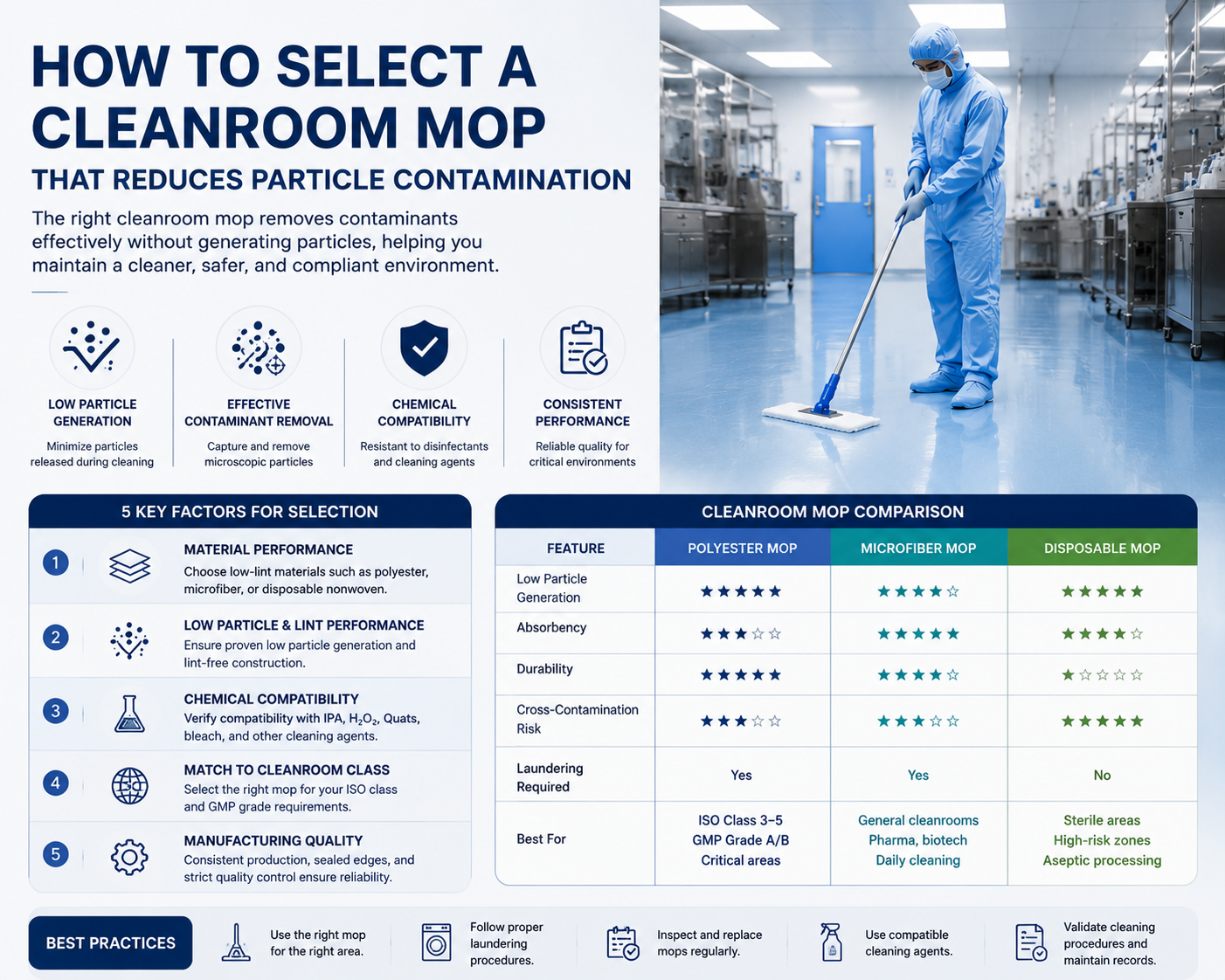
Which Cleanroom Mop Is Best?
There is no single mop suitable for every controlled environment.
The best option depends on the application.
Polyester Cleanroom Mop
Recommended when:
- Ultra-low particle generation is the priority
- Cleaning ISO Class 3–5 cleanrooms
- Frequent exposure to disinfectants is expected
Microfiber Cleanroom Mop
Recommended when:
- High absorbency is required
- Fine particle removal is essential
- Daily pharmaceutical cleaning is performed
Disposable Cleanroom Mop
Recommended when:
- Eliminating laundering risks is critical
- Cleaning sterile production areas
- Preventing cross-contamination between zones
Many manufacturers use a combination of all three to optimize contamination control and operational efficiency.
Why More Facilities Are Adopting Zone-Based Mop Strategies
Instead of relying on a single mop type throughout the facility, many pharmaceutical and electronics manufacturers now assign different mop types to different cleanroom zones.
For example:
- Critical clean zones: Polyester cleanroom mops with ultra-low particle generation.
- General production areas: Microfiber cleanroom mops for superior cleaning efficiency and absorbency.
- Sterile or high-risk zones: Disposable cleanroom mops to eliminate laundering-related contamination.
This strategy improves contamination control while extending the service life of reusable cleaning tools.
Choosing a Reliable Cleanroom Mop Manufacturer
Whether you are a healthcare distributor, pharmaceutical supplier, or OEM brand, selecting the right manufacturing partner is just as important as selecting the right product.
Look for suppliers that offer:
- Cleanroom-grade manufacturing processes
- Low-lint materials
- Custom sizes and mop constructions
- Chemical compatibility validation
- OEM and private-label services
- Stable production capacity
- Comprehensive quality documentation
- Experience serving pharmaceutical, semiconductor, healthcare, and laboratory industries
Reliable manufacturers can help ensure product consistency, regulatory compliance, and long-term supply stability.
Conclusion
Reducing particle contamination starts with choosing the right cleaning tools.
A high-quality cleanroom mop should remove contaminants efficiently while generating as few particles as possible. Material selection, edge construction, chemical compatibility, manufacturing quality, and application requirements all influence cleaning performance.
Rather than focusing only on price, procurement teams should evaluate the total value of a cleanroom mop, including contamination control, durability, compliance, and supplier expertise.
By selecting the appropriate polyester, microfiber, or disposable cleanroom mop for each cleanroom zone, manufacturers can improve operational efficiency, reduce contamination risks, and support consistent product quality.
Frequently Asked Questions (FAQ)
What is the best cleanroom mop for reducing particle contamination?
Polyester cleanroom mops are widely recognized for their ultra-low particle generation, while microfiber mops offer excellent particle capture. Disposable cleanroom mops are preferred in sterile environments where eliminating laundering-related contamination is critical.
Are microfiber mops suitable for ISO cleanrooms?
Yes. Cleanroom-grade microfiber mops are commonly used in pharmaceutical, biotechnology, and medical device facilities because they effectively remove fine particles while maintaining low lint performance.
Why do cleanroom mops need low-lint construction?
Low-lint materials help prevent fibers from becoming airborne or remaining on cleaned surfaces, reducing the risk of contamination and supporting compliance with cleanroom cleanliness standards.
Should pharmaceutical manufacturers use disposable cleanroom mops?
Disposable cleanroom mops are particularly suitable for aseptic processing, sterile manufacturing, and hospital pharmacy cleanrooms, where preventing cross-contamination and simplifying contamination control are top priorities.