 EN
EN

Why Microfilament Cleaning Cloths Produce Less Lint on Critical Surfaces
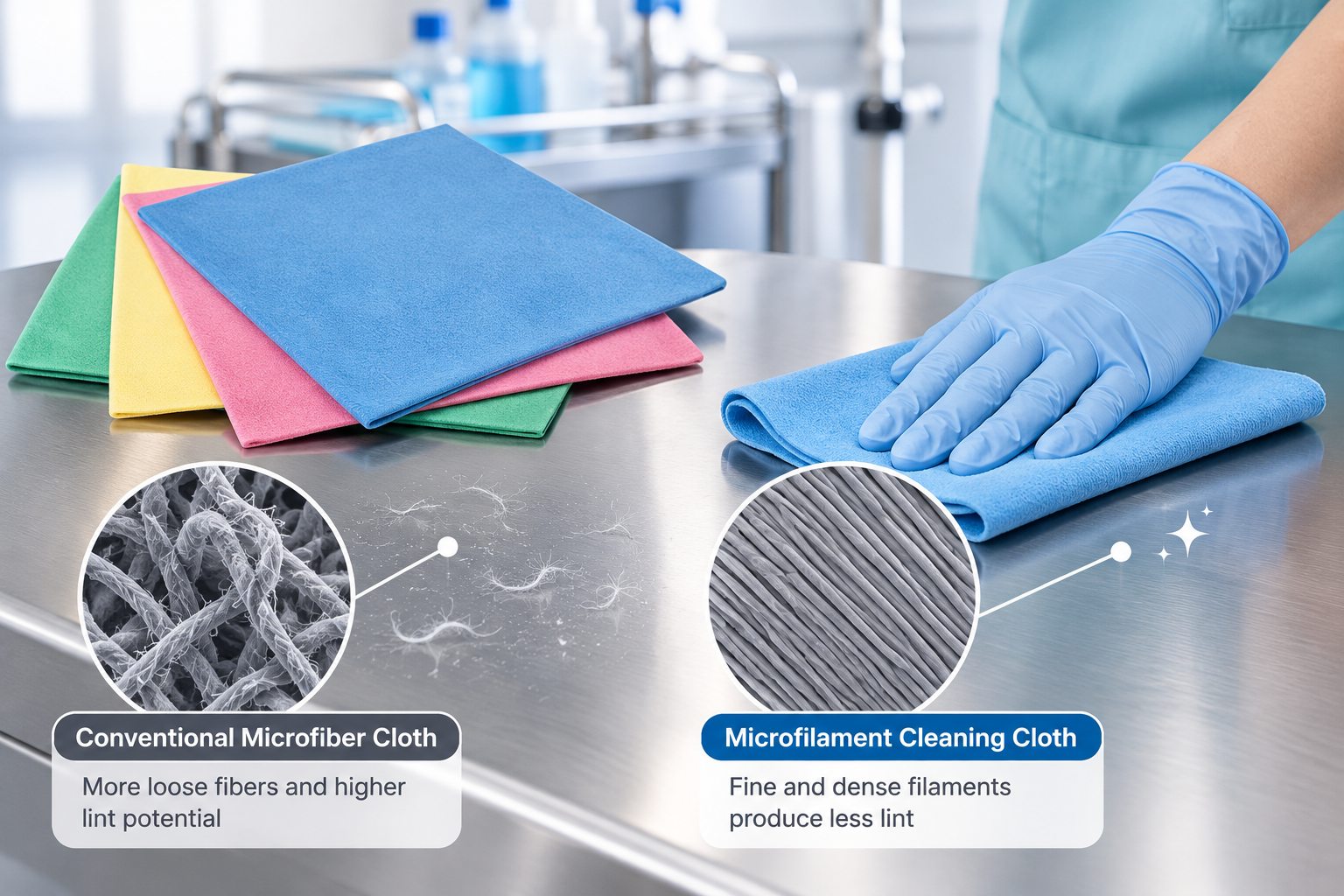
Lint may look like a minor cleaning issue, but on critical surfaces it can become a real operational problem.
In healthcare, laboratories, electronics manufacturing and controlled cleaning environments, loose fibers can remain on glass, stainless steel, equipment housings and other smooth surfaces after wiping.
That is why many professional buyers look for a low-lint cleaning cloth rather than simply choosing a standard microfiber towel.
One material increasingly used for this purpose is the microfilament cleaning cloth.
So why does a microfilament cloth generally produce less lint than a conventional high-pile microfiber cloth?
Short Answer
Microfilament cleaning cloths are often made from very fine synthetic filaments arranged in a dense, thin nonwoven structure.
Compared with thicker knitted microfiber towels, this construction can reduce:
-
Loose surface fibers
-
Fraying
-
Fiber shedding
-
Visible lint after wiping
This makes microfilament cloths especially suitable for applications where clean surface appearance and low particle release are important.
However, buyers should remember:
Low lint does not automatically mean lint-free or cleanroom-qualified.
Actual performance depends on the fiber, manufacturing process, edge construction and application.
What Is a Microfilament Cleaning Cloth?
A microfilament cloth uses extremely fine synthetic filaments, commonly based on polyester and polyamide.
Unlike many conventional microfiber towels, which are knitted into a soft pile structure, microfilament cloths are often produced as a thin nonwoven sheet.
This creates a surface that is:
-
Uniform
-
Smooth
-
Lightweight
-
Dense
-
Low in loose pile
The cloth can make close contact with the surface without relying on long loops or plush fibers.
For professional cleaning, this is one reason microfilament materials are often selected for low-lint wiping.
Why Do Conventional Cloths Produce Lint?
Lint is created when small fibers or fiber fragments separate from the cleaning textile.
Several factors can increase shedding:
Loose Surface Pile
Thick microfiber towels often contain loops or raised fibers.
These provide good absorbency and soil pickup, but lower-quality constructions may release loose fibers during wiping.
Cut Edges
Poorly finished edges can fray after repeated use or laundering.
Fiber Damage
Repeated washing, harsh chemicals or high mechanical stress can weaken fibers.
Rough Surfaces
Textured or sharp surfaces can pull fibers from the cloth.
This is why the same cloth may perform well on a smooth table but shed more on rough equipment.
Why Microfilament Cloths Usually Produce Less Lint
1. Continuous Fine-Filament Structure
Many microfilament products use very fine, relatively continuous filaments.
Because the cleaning surface contains fewer loose pile ends, there are fewer fibers available to detach during wiping.
This is different from a thick terry-style cloth where many individual loops are exposed at the surface.
2. Nonwoven Construction
Microfilament cloths are often produced without traditional woven or knitted loops.
A dense nonwoven structure helps hold the filaments together and can reduce visible fiber shedding.
For buyers, this can be particularly useful when cleaning:
-
Stainless steel
-
Glass
-
Medical equipment surfaces
-
Laboratory benches
-
Screens
-
Smooth plastic surfaces
3. Lower Surface Pile
A low-profile cleaning surface means fewer fibers extend outward from the cloth.
This helps reduce the chance of fibers catching on surface edges or equipment details.
4. Reduced Fraying
Well-manufactured nonwoven microfilament cloths can resist fraying because the material is formed as an integrated sheet rather than from conventional yarns.
This can be especially useful when cloths are repeatedly folded or washed.
Why Is Low Lint Important on Critical Surfaces?
Not every cleaning task requires a low-lint cloth.
For general floor or furniture cleaning, a small amount of fiber shedding may have little practical impact.
Critical surfaces are different.
Healthcare Equipment
Loose fibers can remain on:
-
Bed rails
-
Monitor housings
-
Stainless-steel surfaces
-
Treatment equipment
-
High-touch surfaces
A low-lint cloth helps leave a cleaner visible finish.
Laboratories
Laboratory surfaces often require controlled wiping.
Residual fibers may interfere with visual cleanliness or sensitive work areas.
Electronics
Fiber contamination can be undesirable around:
-
Displays
-
Components
-
Optical surfaces
-
Precision equipment
Glass and Stainless Steel
Lint is particularly noticeable on reflective surfaces.
A smooth microfilament cloth can help reduce:
-
Visible fibers
-
Smearing
-
Residual wiping marks
Microfilament vs Microfiber: Which Produces Less Lint?
In general, a thin nonwoven microfilament cloth can provide lower linting than a thick, high-pile knitted microfiber towel.
However, this is not an absolute rule.
A high-quality knitted microfiber cloth with well-controlled yarn and edging may also produce very little lint.
Professional buyers should therefore compare actual specifications rather than relying only on the product name.
A useful comparison is:
| Feature | Microfilament Cloth | Conventional Microfiber Cloth |
|---|---|---|
| Typical Structure | Thin nonwoven | Knitted / woven |
| Surface Pile | Very low | Low to high |
| Lint Potential | Very low | Depends on construction |
| Absorbency | Moderate | Usually higher |
| Drying Speed | Fast | Usually slower |
| Precision Wiping | Excellent | Good |
| General Cleaning | Good | Excellent |
Does Low Lint Mean Cleanroom Safe?
No.
This is an important distinction for professional buyers.
A cloth can be low lint without being suitable for a cleanroom.
Cleanroom applications may require additional evaluation for:
-
Particle generation
-
Extractable residues
-
Ionic contamination
-
Edge sealing
-
Packaging
-
Cleanliness level
-
Sterilization
-
Cleanroom classification
Therefore, buyers should not accept a claim such as:
“Low lint = suitable for every cleanroom.”
For controlled environments, ask for relevant test data and application-specific qualification.
What Should Buyers Check Before Purchasing?
When sourcing a microfilament cleaning cloth, check more than GSM.
Material Composition
A typical professional cloth may use combinations such as:
70% polyester / 30% polyamide
The actual blend can affect cleaning and absorption performance.
Fabric Construction
Confirm whether the product is:
-
Nonwoven
-
Knitted
-
Woven
-
Split fiber
-
Continuous filament
Lint Performance
Ask whether the supplier has:
-
Fiber-shedding data
-
Particle testing
-
Internal comparison results
Avoid relying only on the phrase “lint-free.”
Washability
For reusable products, confirm:
-
Recommended wash temperature
-
Chemical compatibility
-
Number of wash cycles
-
Dimensional stability
Edge Design
Edge construction can affect shedding.
Buyers should check whether the cloth uses:
-
Cut edges
-
Ultrasonic edges
-
Sealed edges
-
Other low-lint finishing methods
Where Are Microfilament Cloths Most Useful?
Microfilament cloths are particularly suitable when the buyer needs:
-
Low lint
-
Smooth wiping
-
Lightweight handling
-
Fast drying
-
Good surface contact
Typical applications include:
-
Hospitals
-
Healthcare facilities
-
Laboratories
-
Stainless-steel cleaning
-
Glass cleaning
-
Medical equipment
-
Precision surface wiping
-
Controlled industrial environments
Frequently Asked Questions
Why do microfilament cloths produce less lint?
Their thin, dense filament structure generally contains less loose pile than conventional thick microfiber towels, helping reduce fiber shedding during wiping.
Are microfilament cloths completely lint-free?
No textile should automatically be described as zero-lint without supporting test data. “Low lint” is generally a more accurate description.
Are microfilament cloths better than microfiber towels?
Not always. Microfilament cloths are excellent for low-lint precision cleaning, while thicker microfiber towels may provide greater absorbency for general cleaning.
Are microfilament cloths suitable for hospitals?
Yes. They can be useful for wiping smooth surfaces, equipment exteriors and high-touch areas when used according to the facility's cleaning protocol.
Can microfilament cloths be washed?
Many reusable microfilament cloths can be laundered, but buyers should follow the supplier's recommended washing temperature and chemical instructions.
Are low-lint cloths suitable for cleanrooms?
Not automatically. Cleanroom applications may require additional particle, residue and cleanliness testing.
Final Recommendation for Professional Buyers
For critical-surface cleaning, the goal is not simply to choose the softest or thickest cloth.
The better question is:
How much fiber does the cloth leave behind after wiping?
Microfilament cleaning cloths can offer an advantage because their fine, dense and low-profile structure helps minimize loose fibers and visible lint.
For professional buyers, evaluate:
Fiber Structure → Lint Level → Surface Contact → Absorbency → Washability → Application
If low lint and precision wiping are the priority, a microfilament cleaning cloth can be a strong option.
E-SUN provides customizable microfilament cleaning cloths for healthcare, professional cleaning and OEM projects, with options including different sizes, GSM, material compositions, colors and private-label packaging.