 EN
EN

PP, SMS or Polyester: How to Choose Hospital Privacy Curtain Material
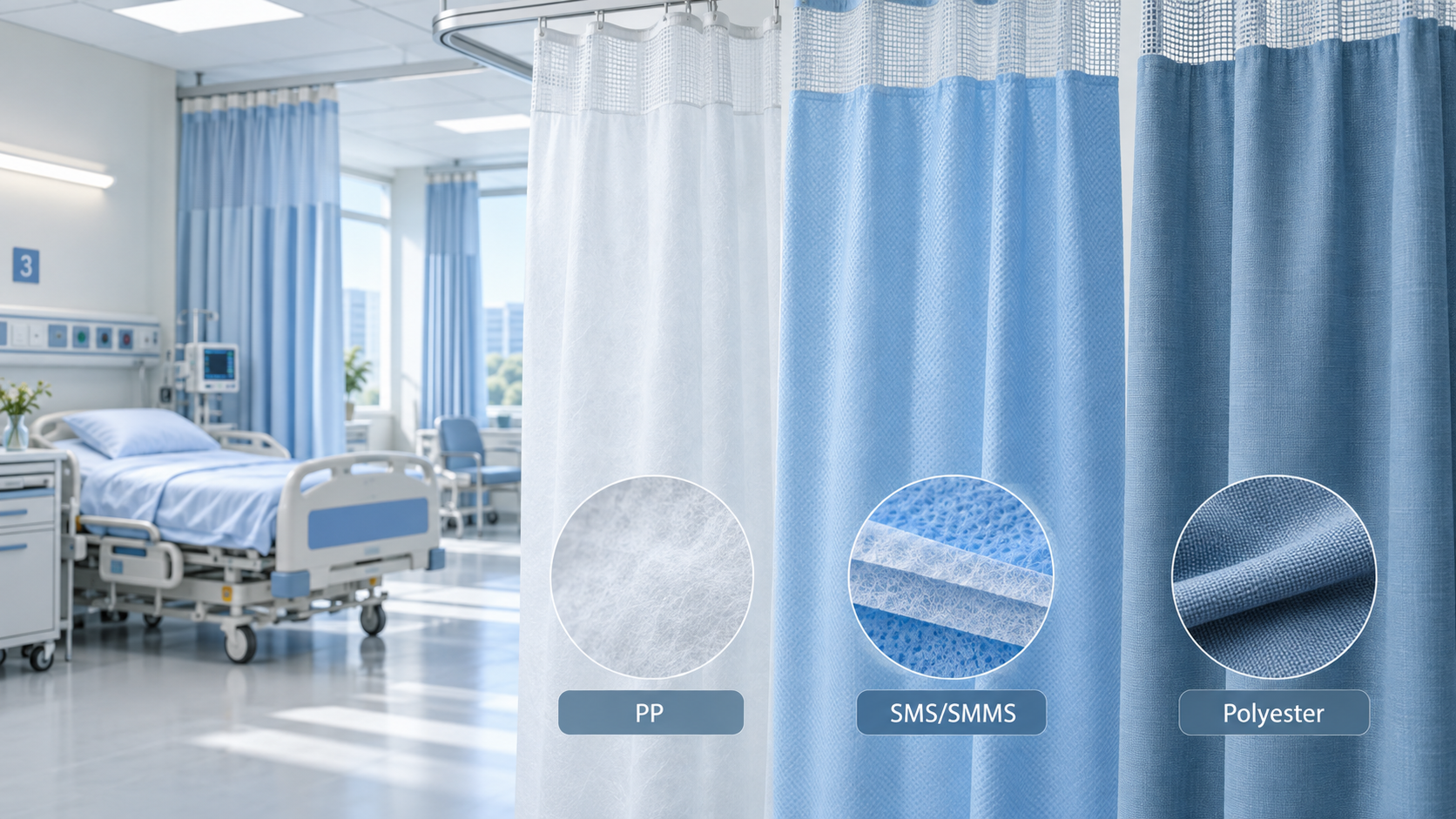
Choosing a hospital privacy curtain is not simply a matter of selecting a color and size.
For hospital procurement teams, healthcare distributors and OEM buyers, one of the first decisions is the curtain material.
Three materials are commonly considered:
PP nonwoven, SMS/SMMS nonwoven and polyester fabric.
They can all be used for medical privacy curtains, but they serve different purposes.
A general patient ward may have very different requirements from an operating department, isolation area or long-term care facility.
So which hospital curtain material should you choose?
The short answer is:
-
PP nonwoven is well suited to disposable privacy curtain programs where easy replacement and cost control are priorities.
-
SMS or SMMS is often selected when buyers want a stronger nonwoven structure and enhanced fluid resistance.
-
Polyester is usually preferred when the hospital wants a durable, reusable privacy curtain that can withstand repeated laundering.
The right choice depends on how the curtain will actually be used.
PP vs SMS vs Polyester Hospital Curtains: Quick Comparison
| Factor | PP Nonwoven | SMS / SMMS | Polyester |
|---|---|---|---|
| Typical Use | Disposable | Disposable | Reusable |
| Weight | Lightweight | Lightweight to medium | Heavier |
| Durability | Moderate | Higher than basic PP | High |
| Fluid Resistance | Basic to moderate | Generally better | Depends on treatment |
| Laundering | Not normally required | Not normally required | Designed for repeated washing |
| Replacement | Easy | Easy | Requires laundry cycle |
| Printing | Excellent | Available | Available |
| Custom Colors | Yes | Yes | Yes |
| Mesh Options | Yes | Yes | Yes |
| High-Turnover Areas | Very suitable | Very suitable | Possible |
| Long-Term Installation | Possible | Possible | Very suitable |
| Procurement Cost | Usually lower initial cost | Mid-range | Higher initial cost |
| Operational Model | Replace and dispose | Replace and dispose | Remove, wash and reinstall |
The important point is that there is no single “best” material.
The material should match the facility's cleaning and replacement workflow.
1. What Is a PP Nonwoven Hospital Privacy Curtain?
PP stands for polypropylene.
Polypropylene nonwoven fabric is one of the most common materials used for disposable hospital privacy curtains.
Unlike a traditional woven textile, the fibers are bonded together to create a lightweight nonwoven sheet.
This construction makes PP practical for disposable applications.
Typical PP privacy curtains may offer:
-
Lightweight construction
-
Easy installation
-
Flexible customization
-
Digital printing
-
Color options
-
Optional antimicrobial treatment
-
Optional mesh
-
Easy replacement
For many hospital projects, PP is selected because the curtain does not need to enter a laundry cycle.
When replacement is required, staff can remove the curtain and install a new one.
Where Does PP Work Best?
PP disposable curtains can be suitable for:
-
General patient wards
-
Isolation rooms
-
Emergency departments
-
Rehabilitation centers
-
Temporary healthcare facilities
-
Long-term care facilities
-
Clinics
-
High-turnover patient areas
They are especially practical when the facility wants to simplify curtain replacement.
Typical PP Curtain Specifications
For example, disposable PP hospital curtains may be manufactured around 120 GSM, with lighter or heavier options available depending on the project.
Common customization can include:
-
2.0 m height
-
2.3 m height
-
2.5 m height
-
Customized height
-
2.5 m, 3.5 m, 7 m or 7.5 m length
-
Pantone color matching
-
Digital printing
-
C-hooks
-
Eyelets
-
Mesh
-
Perforated mesh
-
Antimicrobial options
This flexibility makes PP particularly suitable for OEM and distributor projects.
2. What Is an SMS Hospital Privacy Curtain?
SMS stands for:
Spunbond + Meltblown + Spunbond
SMMS adds another meltblown layer.
Instead of using one simple nonwoven structure, SMS combines several layers.
The outer spunbond layers provide strength, while the meltblown layer helps improve barrier performance.
This is why SMS materials are commonly associated with healthcare disposable products.
For hospital privacy curtains, SMS can be useful when buyers want more than a basic disposable fabric.
Why Choose SMS or SMMS?
Compared with standard PP nonwoven, SMS/SMMS can provide:
-
Stronger multilayer construction
-
Better fluid barrier performance
-
Good tear resistance
-
Lightweight handling
-
Disposable convenience
-
Cleaner, more technical appearance
For some medical projects, especially areas where fluid exposure is a greater concern, SMS can be a more suitable specification.
Typical curtain material weights may fall around 80–130 GSM, depending on construction and performance requirements.
Where Is SMS Most Suitable?
SMS hospital curtains may be considered for:
-
Operating department areas
-
Isolation environments
-
Treatment rooms
-
High-risk clinical zones
-
Emergency departments
-
Temporary isolation areas
-
Projects requiring enhanced fluid resistance
That does not mean SMS is automatically required in every clinical area.
For a standard patient room, PP may already meet the operational requirement.
This is why buyers should avoid over-specifying the product.
More material does not always mean better value.
3. What Is a Polyester Hospital Privacy Curtain?
Polyester represents a very different purchasing strategy.
Instead of replacing the curtain after a defined period, polyester curtains are generally designed to be:
removed → laundered → inspected → reinstalled.
A hospital that already operates a textile management or laundry program may therefore prefer reusable polyester curtains.
Compared with disposable nonwoven materials, polyester usually provides:
-
Greater durability
-
More substantial fabric feel
-
Longer service life
-
Better drape
-
Repeated laundering capability
-
Decorative jacquard options
-
Permanent-looking installation
A typical reusable medical curtain may use around 220 GSM polyester fabric, although specifications vary considerably.
Where Does Polyester Work Best?
Reusable polyester curtains can work well in:
-
General wards
-
Long-term care
-
Rehabilitation hospitals
-
Clinics
-
Private hospitals
-
Areas with lower replacement frequency
-
Facilities with established laundry systems
Polyester is particularly logical when the hospital already has processes for collecting, washing, storing and reinstalling curtains.
Disposable or Reusable: The Bigger Question
When buyers compare PP, SMS and polyester, they are actually making two decisions.
The first is:
Which material performs best?
The second — and often more important — is:
Do we want a disposable or reusable curtain system?
The answer affects much more than the curtain itself.
A reusable curtain system requires:
-
Curtain removal
-
Collection
-
Transport
-
Laundry
-
Drying
-
Inspection
-
Storage
-
Replacement inventory
-
Reinstallation
A disposable system generally removes several of those steps.
This is why procurement teams should compare total operating workflow, not only curtain unit price.
PP vs SMS: What Is the Difference for Hospital Buyers?
PP and SMS are often confused because both are nonwoven polypropylene-based materials.
The key difference is the structure.
Basic PP spunbond material has a relatively simple construction.
SMS incorporates a meltblown layer between spunbond layers.
For buyers, the practical difference is generally:
Choose PP When:
-
Cost efficiency is important
-
Standard disposable privacy is required
-
The curtain is used in a general ward
-
Printing and customization are priorities
-
Fast replacement matters
-
A basic medical nonwoven structure is sufficient
Consider SMS When:
-
Greater barrier performance is required
-
The project involves higher clinical risk
-
Fluid resistance is more important
-
A stronger multilayer material is preferred
-
The specification specifically requests SMS or SMMS
A hospital should not automatically pay for SMS if the application does not require it.
At the same time, choosing the cheapest PP solely to reduce purchase cost can create problems if the material is too thin, tears easily or does not meet the facility's requirements.
PP vs Polyester: Which Is More Cost-Effective?
This depends on how cost is calculated.
If buyers compare only initial purchase price:
PP disposable curtains generally have a lower unit cost.
But if a hospital keeps curtains installed for long periods and has an efficient laundry system, reusable polyester may provide a different long-term cost structure.
A better calculation is:
Total Curtain Cost = Purchase + Installation + Laundry + Labor + Storage + Replacement + Disposal
This makes purchasing discussions much more realistic.
For example, a reusable curtain may last through many wash cycles, but each cycle requires handling and laundry.
A disposable curtain has no laundry cost, but it requires replacement stock.
Neither system is automatically cheaper for every hospital.
What About Infection Control?
Hospital privacy curtains are frequently touched surfaces.
That makes replacement and handling procedures important.
However, buyers should be careful with claims such as:
“Disposable is always more hygienic.”
or
“Antimicrobial fabric prevents hospital infections.”
Material alone cannot replace proper infection-prevention procedures.
A hospital's curtain program should consider:
-
Replacement frequency
-
Visible contamination
-
Patient turnover
-
Isolation protocols
-
Hand hygiene
-
Environmental cleaning procedures
-
Correct curtain handling
The operational advantage of a disposable curtain is that it can simplify replacement.
There is no need to send it through a textile reprocessing cycle.
For isolation rooms and high-turnover areas, this simplicity can be valuable.
Do Hospital Curtains Need Antimicrobial Treatment?
Antimicrobial treatment is available for some PP and polyester curtain materials.
It can be considered when the project specifically requests it.
However, professional buyers should ask for more than the word “antibacterial.”
Ask the supplier:
-
Which test standard was used?
-
Which microorganisms were tested?
-
What reduction level was achieved?
-
Is the treatment durable?
-
How many washing cycles can it withstand?
-
Is the test performed on the actual finished curtain or only the raw material?
For reusable polyester curtains, laundering durability is especially important.
If antimicrobial performance disappears after a small number of wash cycles, it may provide little practical value over the curtain's service life.
Fire Retardancy: A Critical Purchasing Specification
Fire performance is another area where hospital buyers should avoid assumptions.
Different markets may request different standards.
Examples commonly encountered in healthcare curtain procurement include:
-
NFPA 701 for certain U.S. projects
-
BS 5867 for certain UK projects
-
Other national or facility-specific requirements
The required test depends on the market, project specification and intended installation.
A supplier should therefore be able to provide the correct documentation for the specific project rather than simply stating that the curtain is “fireproof.”
“Fire resistant” and “tested to a specified fire standard” are not the same thing.
What About Mesh?
Many hospital privacy curtains incorporate mesh at the top.
Mesh can help maintain airflow and visibility of ceiling-mounted equipment or sprinkler systems, depending on the installation design.
Common options include:
-
Sewn mesh
-
Integrated mesh
-
Perforated nonwoven
-
Continuous mesh
-
Snap-panel systems
When sourcing curtains, buyers should provide the supplier with:
Floor-to-track height + required curtain clearance + required mesh height
instead of simply saying:
“We need a 2-meter curtain.”
This reduces sizing mistakes.
Hospital Privacy Curtain Material Selection by Area
A practical purchasing strategy can look like this:
| Hospital Area | Material to Consider | Reason |
|---|---|---|
| General Patient Ward | PP or Polyester | Depends on disposable vs laundry system |
| Isolation Room | PP / SMS | Easy replacement |
| Emergency Department | PP / SMS | High turnover |
| Operating/Clinical Area | SMS / SMMS | Higher barrier specification may be required |
| Long-Term Care | PP or Polyester | Depends on replacement policy |
| Rehabilitation Facility | PP or Polyester | Both systems possible |
| Temporary Ward | PP | Easy installation and replacement |
| Premium Private Ward | Polyester | Durable textile appearance |
| Outbreak Response | Disposable PP / SMS | Simplified replacement |
This should not replace a hospital's own infection-control or fire-safety requirements, but it gives procurement teams a useful starting point.
What Should Distributors Ask a Hospital Before Quoting?
For healthcare distributors, one of the biggest mistakes is requesting a curtain quotation with only:
“Please quote hospital curtain.”
Before asking a manufacturer for pricing, confirm at least these specifications.
1. Disposable or Reusable?
This immediately determines the likely material direction.
2. Application Area
Is the curtain for:
-
General wards?
-
ICU?
-
Isolation rooms?
-
Operating areas?
-
Long-term care?
3. Required Material
Does the tender specify:
-
PP?
-
SMS?
-
Polyester?
4. GSM
Do not assume all 120 GSM PP fabrics perform the same.
Fabric construction and finishing matter too.
5. Curtain Dimensions
Confirm finished dimensions, not estimated track dimensions.
6. Mesh Requirement
Specify mesh height and construction.
7. Fire Standard
Ask which certification the buyer actually requires.
8. Antimicrobial Requirement
Confirm whether it is mandatory or optional.
9. Installation System
Does the hospital use:
-
Hooks?
-
Eyelets?
-
Snaps?
-
Disposable panels?
-
Existing ceiling tracks?
10. Printing and Color
Hospitals may request:
-
Solid colors
-
Custom Pantone colors
-
Printed patterns
-
Hospital branding
-
Children's ward patterns
Getting these answers before quotation reduces repeated sampling and specification changes.
What Should OEM Buyers Consider?
OEM buyers have a different priority.
Instead of purchasing one hospital project, they may be developing an entire privacy curtain product line.
In that case, a practical range may include:
Entry-Level Disposable Curtain
PP nonwoven
Standard colors
Standard hook system
Enhanced Disposable Curtain
Higher-GSM PP or SMS
Optional antimicrobial treatment
Custom printing
High-Barrier Medical Curtain
SMS / SMMS
Fluid-resistant construction
Project-specific performance requirements
Reusable Premium Curtain
Polyester
Jacquard fabric
Optional antimicrobial or fire-retardant treatment
Custom colors and patterns
This gives distributors a clearer product ladder instead of offering dozens of nearly identical curtains.
Common Mistakes When Buying Hospital Privacy Curtains
Mistake 1: Choosing Material Based Only on Price
A cheaper curtain may not meet durability or compliance requirements.
Mistake 2: Using GSM as the Only Quality Indicator
Two fabrics with the same GSM can have different strength, structure and surface performance.
Mistake 3: Ignoring the Existing Track System
A good curtain that does not fit the existing system creates additional installation cost.
Mistake 4: Asking for “Antibacterial” Without a Test Standard
Always request supporting test information.
Mistake 5: Forgetting Replacement Workflow
The material should match how the hospital actually removes, cleans and replaces curtains.
Mistake 6: Assuming One Material Fits Every Hospital Area
Hospitals may use different curtain systems in different departments.
A mixed-material strategy is often more practical.
Frequently Asked Questions
Which material is best for disposable hospital privacy curtains?
PP nonwoven is commonly used for standard disposable privacy curtains because it is lightweight, customizable and easy to replace. SMS may be considered when stronger multilayer construction or enhanced barrier performance is required.
Is SMS better than PP?
Not in every application.
SMS offers a multilayer structure and may provide stronger barrier performance, but standard PP may be more cost-effective for general ward applications.
Is polyester suitable for hospital privacy curtains?
Yes.
Polyester is commonly used for reusable hospital privacy curtains, particularly where the facility has an established laundry program.
Which material is easiest to replace?
Disposable PP and SMS curtains are generally easier to replace because laundering and textile return logistics are eliminated.
Can PP hospital curtains be printed?
Yes.
PP nonwoven curtains can be produced in custom colors and printed designs, making them suitable for children's wards, private rooms and branded healthcare projects.
Can hospital curtains include mesh?
Yes.
PP, SMS and polyester hospital curtains can all be designed with mesh depending on the curtain construction and project requirements.
Which material is best for isolation rooms?
Disposable PP or SMS curtains are often practical because they simplify replacement. Final selection should follow the healthcare facility's infection-control protocol.
Does a hospital privacy curtain need to be fire retardant?
Requirements depend on the country, facility and project specification. Buyers should confirm the required fire-performance standard before placing an order.
Final Recommendation for Professional Buyers
Instead of asking:
“Which hospital curtain material is the best?”
ask:
“Which material fits this hospital's environment, replacement process and compliance requirements?”
A simple purchasing framework is:
PP → practical disposable solution for general healthcare use.
SMS / SMMS → disposable option for projects requiring stronger multilayer construction or enhanced barrier performance.
Polyester → reusable solution for facilities with established laundry and textile-management systems.
For healthcare distributors and OEM buyers, there is often no need to choose only one material.
A well-designed hospital curtain product range can include all three.
The most important purchasing factors are:
Application → Material → Disposable or Reusable → GSM → Fire Requirement → Antimicrobial Requirement → Mesh → Track Compatibility → Customization → Total Operating Cost
E-SUN manufactures customizable hospital privacy curtains for healthcare facilities, distributors and OEM projects, including PP nonwoven disposable curtains, SMS/SMMS medical curtains and reusable polyester curtain systems. Available options include custom dimensions, colors, digital printing, mesh, hooks, snap panels and private-label packaging.