 EN

Polyester vs Polyester-Polyamide Disposable Mop Pads: What Changes in Use?
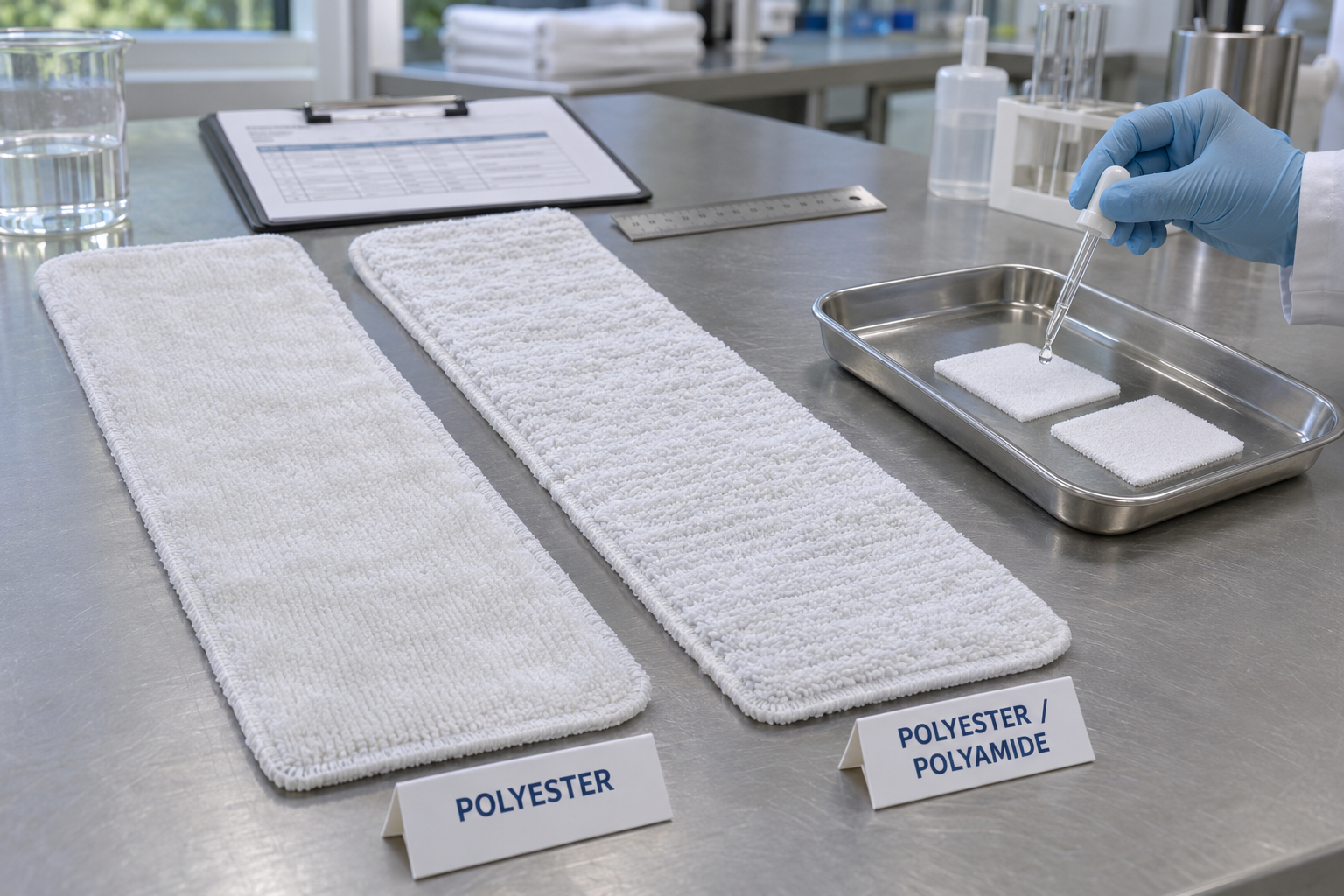
Two disposable mop pads can have the same dimensions and a similar appearance, yet behave differently once they are wetted and fitted to a frame. One may absorb solution quickly but feel heavy during use. Another may move easily across the floor but deliver liquid unevenly.
Material composition helps explain these differences, but it is only part of the picture.
Polyester and polyester-polyamide disposable mop pads can differ in wetting, liquid retention, soil pickup and handling. However, fiber fineness, splitting, fabric structure, finishing and pad construction also influence performance. Neither composition is automatically the better choice for every cleaning task.
For hospital buyers, cleaning contractors and distributors, the useful comparison is how the finished pads perform under the same working conditions.
What Is the Material Difference?
A polyester disposable mop pad uses polyester fibers in the specified component. A polyester-polyamide pad combines polyester with polyamide, commonly called nylon. Blend ratios such as 80/20 or 70/30 should identify which percentage belongs to each polymer.
Buyers should also ask whether the composition refers to the cleaning face or the entire finished pad. A polyester-polyamide cleaning layer may be combined with a polyester backing, pockets or another internal material.
“Microfiber” describes fiber fineness rather than a single polymer recipe. A polyester pad can use fine fibers, while a polyester-polyamide product may use split composite fibers. The composition label alone does not establish the finished fiber size or degree of splitting.
These distinctions matter when comparing quotations. Two suppliers may describe different constructions using almost identical product names.
1. Wetting Speed and Liquid Uptake
Polyamide generally has a greater affinity for moisture than polyester. However, liquid held by a mop pad also occupies the spaces between fibers and within the fabric structure.
This means a 100% polyester pad can still take up substantial liquid through its construction and surface treatment. Likewise, a polyester-polyamide blend does not guarantee rapid wetting.
Research on split polyester-polyamide fabrics shows that splitting conditions, pore structure and finishing can change absorption behaviour. Those studies support examining the processed fabric, rather than predicting performance from the blend ratio alone. They do not establish a universal ranking for disposable mop pads.
For buyers, the practical questions are straightforward: How quickly does the pad wet out? Does the liquid spread evenly? Are dry areas left inside a prepared stack?
Test these points using the intended cleaning solution and preparation time.
2. Liquid Retention and Solution Release
A pad that holds more liquid does not necessarily apply more liquid to the floor.
Absorption capacity measures uptake under defined conditions. Solution release concerns how that liquid is delivered during movement and pressure. Both matter, but they should be evaluated separately.
A highly retentive pad may need a different starting liquid load to achieve the required application. A pad that releases liquid rapidly may leave too much at the beginning and too little toward the end of the cleaning section.
For applicable nonwoven materials, ISO 9073-6:2025 provides absorption test methods. It does not replace a practical evaluation of floor wetting, solution release or cleaning coverage.
Compare the pads at the beginning, middle and end of the assigned task. Where disinfection is required, follow the disinfectant’s instructions for application and contact time.
3. Soil Pickup and Cleaning Results
Both polyester and polyester-polyamide pads can support mechanical soil removal. The result depends on how the cleaning surface contacts the floor and captures debris.
Fine split fibers can create a different surface from unsplit fibers. Loops, textured patterns and scrubbing strips also change the interaction with soil.
A smooth polyester pad and a textured polyester-polyamide pad therefore differ in more than composition. If one cleans better, the trial does not show that the polymer blend caused the improvement.
Evaluate representative soil on the intended flooring. Look for remaining marks, debris pushed toward the edges and the number of passes required.
Avoid extending a microbial-removal result from one tested product to all pads with the same composition. Neither polyester nor polyamide content independently demonstrates antibacterial activity or reduced hospital infection rates.
4. Drag and Operator Effort
Operators may notice handling differences before they notice changes in cleaning results.
A pad can feel comfortable when lightly damp and difficult to move when heavily saturated. Textured floors, frame pressure and fabric surface design can all affect drag.
Research comparing microfiber cleaning cloths found substantial variation in fabric construction and noted high friction for many samples under damp conditions. These cloth findings highlight a factor worth testing; they should not be treated as a direct performance prediction for every mop pad.
Ask staff to evaluate forward strokes, backward movement, turning and edge cleaning. Keep the frame, floor and liquid preparation consistent.
The preferred pad should allow controlled movement while achieving the required cleaning result.
5. Chemical Compatibility
Do not select a pad for disinfectant use solely because it contains polyester or a particular percentage of polyamide.
The complete product includes more than the cleaning fibers. Backing materials, bonding, pockets and finishes also come into contact with the solution.
CDC guidance cautions that microfiber is not compatible with all disinfectant products and can be affected by high-pH formulations, particularly some chlorine-based products.
Give the supplier the actual chemical formulation, use concentration and expected exposure time. Check wet strength, attachment stability and solution delivery after preparation.
For disposable pads, short-term functional compatibility is more relevant than a claim about surviving repeated laundering. However, single use does not remove the need for compatibility evidence.
6. Lint Release and Product Integrity
A polyester-only composition does not automatically mean low lint, and adding polyamide does not automatically increase shedding.
Fiber length, yarn structure, bonding, cutting and edge finishing all influence the finished product. Handling and wet abrasion can reveal issues that are not obvious in a dry sample.
Inspect the pad after the intended cleaning task. Check for loose fibers, torn edges, separated layers and damaged attachment areas.
Where particle release is important, request test results with the method and reporting units. For controlled environments, material composition should be assessed alongside the application’s cleanliness requirements.
A Practical Comparison for Buyers
| Evaluation point | What buyers should compare |
|---|---|
| Composition | Cleaning-face ratio and materials in other layers |
| Wetting | Time and uniformity using the intended solution |
| Liquid handling | Uptake, retention and release measured separately |
| Cleaning result | Soil remaining and passes required |
| Operator handling | Drag, turning and frame stability |
| Compatibility | Performance after actual chemical exposure |
| Integrity | Fiber release, edge condition and attachment strength |
Use samples with comparable dimensions, construction and weight where possible. When they differ, record those differences so the trial remains interpretable.
For an OEM decision, it can be useful to run two comparisons: one using the same preparation conditions, and another using each product’s recommended preparation. The first helps compare behaviour; the second shows how each proposed system would work in practice.
Compare Cost per Completed Task
A price difference should be assessed against usable performance.
Record pad consumption, solution use, preparation time and any repeat cleaning. A higher-priced blend may be worthwhile if a verified benefit improves the task. A polyester option may be preferable if it meets the same requirements at a lower total cost.
For ESUN OEM/ODM enquiries, buyers can provide the intended floor, cleaning chemicals, frame details and preparation method. Agreeing on measurable requirements makes material selection more useful than choosing a blend ratio in isolation.
Frequently Asked Questions
Is polyester-polyamide always better than polyester?
No. It may offer useful characteristics in a particular construction, but the finished pad needs to be tested against the intended task.
Can a 100% polyester disposable pad be absorbent?
Yes. Liquid uptake depends on fiber arrangement, fabric structure and finishing as well as polymer composition.
Does a higher polyamide percentage mean better cleaning?
Not necessarily. Blend ratio alone does not establish fiber splitting, soil removal, solution release or handling performance.
What should an OEM specification include?
State the composition of each relevant layer, dimensions, tolerances, attachment design, performance methods, chemical conditions and acceptance limits.