 EN
EN

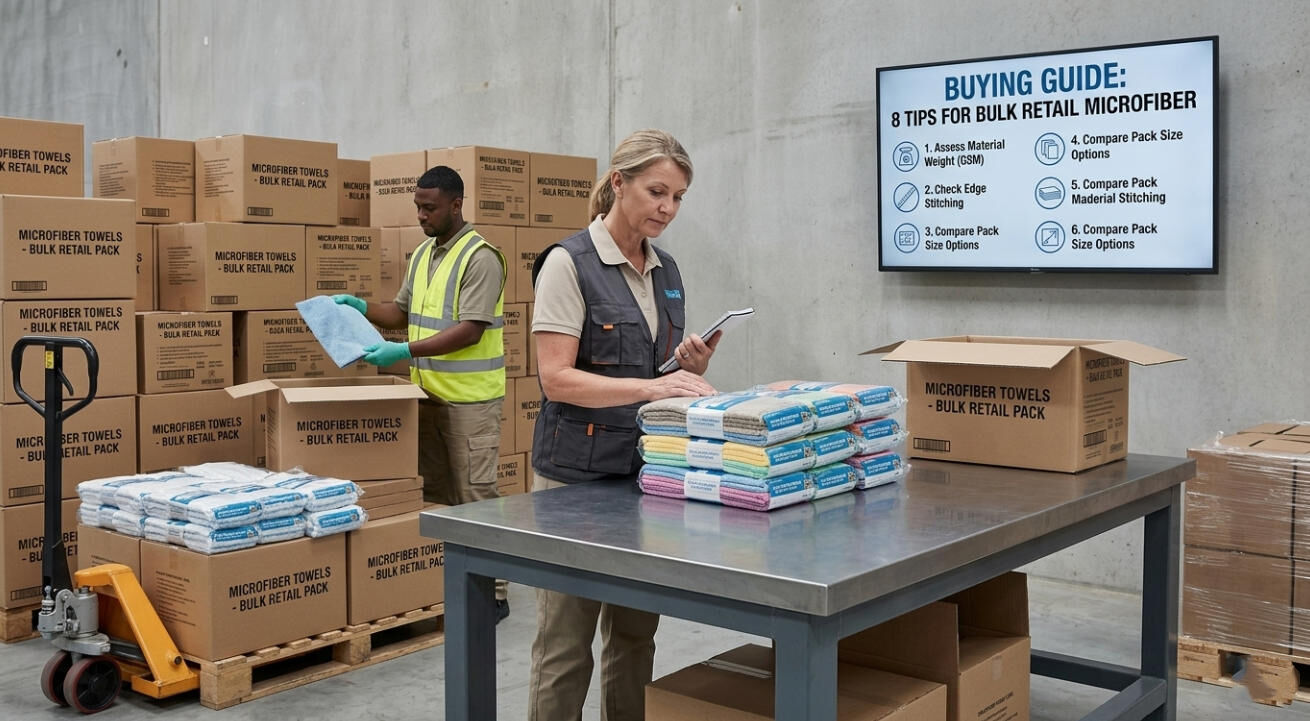
Understand Core Quality Metrics: GSM, Fiber Split, and Weave Density
Why GSM (grams per square meter) is the most reliable indicator of microfiber towel durability and performance
GSM measures fabric weight per square meter—and for microfiber towels, it’s the strongest predictor of real-world performance. Lightweight cloths at 200 GSM suit basic dusting but lack resilience; premium retail-grade towels start at 400 GSM and extend to 600+ GSM to ensure thick, durable loops that absorb more liquid and resist tearing. Higher GSM reflects greater density of the polyester-polyamide blend, enabling the towel to endure hundreds of commercial wash cycles without thinning. Industry testing confirms that a 500 GSM microfiber towel retains over 90% of its original absorbency after 200 washes, while a 300 GSM version loses nearly 40% of its effectiveness within just 50 cycles. For B2B buyers, GSM is the single most actionable metric for forecasting long-term cost-per-use—overlooking it invites premature replacement and hidden operational expenses.
How a true 3–6 split fiber structure enables superior absorbency, lint-free cleaning, and surface safety
Not all microfibers deliver equal performance. A genuine split microfiber undergoes a controlled chemical process that divides each filament into three to six wedge-shaped lobes—dramatically increasing surface area. These split fibers act like microscopic hooks, drawing in and trapping dust, oils, and moisture within the fiber rather than smearing them across surfaces. The result is consistently lint-free cleaning, essential for automotive paint and optical glass. Independent lab tests show split-fiber microfiber achieves 98% particle removal versus just 72% for unsplit alternatives. Meanwhile, the polyamide core ensures softness and flexibility, preventing scratches on delicate finishes. Retail buyers should request supplier documentation verifying true 3–6 split construction—many budget “microfiber” towels use solid filaments with none of these functional advantages.
Weave density essentials: Why tight, uniform microfiber construction prevents fraying and extends wash life
Weave density determines structural integrity—not just how a microfiber towel feels, but how long it lasts. A high-density weave tightly interlocks loops across the entire fabric, eliminating gaps where fibers can loosen or pull free. Premium towels typically use a double terry weave that locks loops on both sides, resisting unraveling even after 500+ wash cycles. In contrast, low-density weaves develop weak points quickly: edge hems often separate by the 50th wash, shedding lint onto sensitive surfaces. Retailers should inspect edge binding and look for reinforced borders—tight, uniform construction preserves pile height, maintains softness, and sustains absorbency for years, not weeks.
Match Microfiber Towel Specifications to End-User Applications
Sourcing the right microfiber towel depends entirely on the end user’s environment. Each retail segment demands distinct physical properties—from absorbency and drying speed to fiber softness and abrasion resistance.
Gym & Fitness Retail: High-Absorbency, Quick-Drying Microfiber Towels with Odor-Resistant Finishes
Gym-goers demand towels built for high sweat volume and frequent laundering. Top-performing gym towels use a 300–400 GSM split-fiber construction (70% polyester, 30% polyamide) to absorb up to seven times their weight in water while drying three times faster than cotton. This rapid moisture release inhibits bacterial growth and minimizes locker-room odor—even after repeated washing. Many leading suppliers now integrate certified antimicrobial finishes, such as silver-ion treatments, validated to remain effective for 50+ wash cycles—extending usable life in demanding fitness environments.
Automotive Detailing Retail: Ultra-Soft, High-Pile Microfiber Towels Engineered for Scratch-Free Paint and Glass
Automotive detailers require precision tools—not just cleaning cloths. The industry standard is a high-pile microfiber towel with 350–500 GSM density and a verified 80/20 polyester–polyamide split. Longer fibers create a plush cushion that lifts abrasive particles away from clear coats, preventing micro-scratches. For glass and polish removal, low-pile or waffle-weave variants offer controlled friction and streak-free results. Properly specified detailing towels maintain lint-free performance across 200+ commercial wash cycles—directly lowering per-job consumable costs without compromising finish quality.
Calculate True Cost-Per-Use—Not Just Wholesale Price Per Microfiber Towel
Modeling long-term value: How 500+ wash cycles in premium microfiber towels reduce COGS by up to 62%
Many B2B buyers fixate on upfront wholesale price—but the decisive financial metric is cost-per-use. Premium microfiber towels engineered with high GSM and true fiber splitting routinely withstand 500+ wash cycles, whereas low-grade alternatives often fail before 50 uses. To calculate cost-per-use, divide the towel’s unit price by its expected wash life and add nominal laundering costs per cycle. For example, a $2.00 premium towel lasting 500 washes yields $0.004 per use—plus minimal water and detergent. A $0.50 budget towel lasting only 50 washes yields $0.010 per use—more than double. Over time, this difference reduces cost of goods sold (COGS) by up to 62%, making rigorously specified microfiber towels the more profitable choice for retailers committed to long-term value.
Identify and Avoid Misleading Marketing Claims in Bulk Microfiber Towel Sourcing
Misleading claims waste budgets and supply inferior products. Bulk buyers must decode common red flags to avoid overpaying for marketing hype rather than genuine quality.
Red flags decoded: 'Nano-fiber', 'ionic weave', and unverified 'antibacterial' labels on microfiber towel packaging
“Nanofiber” has no accepted industry definition in microfiber textiles—true performance hinges on measurable specs like GSM and verified fiber-split ratio, not buzzwords. “Ionic weave” sounds technical but lacks any standardized meaning or proven functional benefit—it’s pseudo-scientific marketing. “Antibacterial” claims are only credible when supported by third-party lab certification (e.g., ISO 20645); without it, the label is meaningless. Similarly, vague assertions like “99.5% dirt removal” reflect baseline performance for any properly split microfiber—not a differentiating advantage. Buyers should insist on data sheets confirming minimum GSM (≥300), verified 3–6 split fiber composition, and uniform weave density. Rely on objective specifications—not invented terminology—to ensure every bulk purchase delivers durable, high-performance cleaning power.
FAQ
What does GSM mean, and why is it important for microfiber towels?
GSM stands for grams per square meter, which measures the weight and density of fabric. It is a strong indicator of a microfiber towel's durability, absorbency, and lifespan, with higher GSM values typically offering superior performance.
How can I ensure a microfiber towel uses true split fiber construction?
Ask suppliers for documentation verifying a 3–6 split fiber structure. True split fibers improve absorbency, ensure lint-free cleaning, and protect delicate surfaces from scratches.
What microfiber towel specifications suit gym and fitness environments?
A towel with 300–400 GSM split-fiber construction (70% polyester, 30% polyamide) works best, offering high absorbency, quick drying, and resistance to odor and bacterial growth.
How do I calculate the cost-per-use for microfiber towels?
Divide the unit price of a towel by its expected wash life and include laundering costs. Premium towels with extended wash cycles have a significantly lower cost-per-use over time.
What are common misleading marketing claims for microfiber towels?
Terms like “nanofiber” and “ionic weave” lack standardized definitions or proven benefits. Unverified “antibacterial” labels should also be scrutinized—look for certifications like ISO 20645.
Table of Contents
-
Understand Core Quality Metrics: GSM, Fiber Split, and Weave Density
- Why GSM (grams per square meter) is the most reliable indicator of microfiber towel durability and performance
- How a true 3–6 split fiber structure enables superior absorbency, lint-free cleaning, and surface safety
- Weave density essentials: Why tight, uniform microfiber construction prevents fraying and extends wash life
- Match Microfiber Towel Specifications to End-User Applications
- Calculate True Cost-Per-Use—Not Just Wholesale Price Per Microfiber Towel
- Identify and Avoid Misleading Marketing Claims in Bulk Microfiber Towel Sourcing
-
FAQ
- What does GSM mean, and why is it important for microfiber towels?
- How can I ensure a microfiber towel uses true split fiber construction?
- What microfiber towel specifications suit gym and fitness environments?
- How do I calculate the cost-per-use for microfiber towels?
- What are common misleading marketing claims for microfiber towels?