 EN
EN

How Can Hospital Buyers Choose a Reliable Microfiber Disposable Mop Manufacturer?
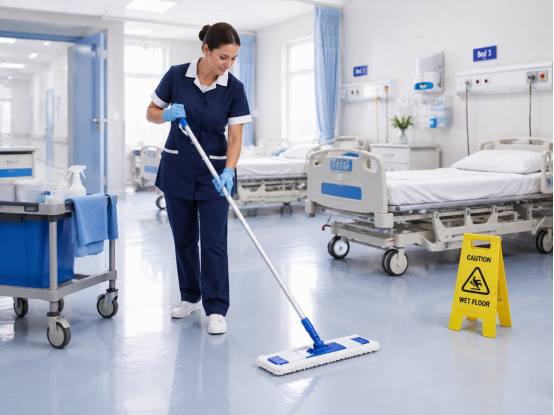
Choosing the right microfiber disposable mop manufacturer is important for hospitals, healthcare facilities, and medical cleaning supply distributors. Price matters, but cleaning performance, quality consistency, testing, customization, and supply stability are equally important.
Here are the key factors buyers should consider before selecting a supplier.
1. Check Cleaning Performance
A disposable mop should provide consistent cleaning throughout its intended coverage area.
Hospital buyers should evaluate:
- Microorganism and soil removal
- Cleaning coverage per pad
- Absorbency and solution release
- Scrubbing performance
- Mop integrity during use
Instead of comparing only the price per piece, consider the cost per cleaning task or cleaned area.
2. Ask for Microorganism Removal Data
Microfiber disposable mops used in healthcare environments may be evaluated against microorganisms such as C. difficile, MRSA, VRE, or E. coli.
If a supplier claims “99.9% microorganism removal,” buyers should ask for supporting test information.
Check:
- Which microorganism was tested?
- Which test method was used?
- Under what conditions was it tested?
- Does the report apply to the product being purchased?
Reliable manufacturers should be able to support important performance claims with relevant technical documentation.
3. Evaluate Material and Mop Construction
Not all microfiber mop pads are the same.
Performance can be affected by:
Fiber composition: Polyester, polyamide, microfiber, and microfilament structures provide different cleaning and liquid-management properties.
GSM: Higher GSM does not automatically mean better performance. The correct GSM should match the cleaning application.
Scrubbing structure: Additional scrubbing fibers or stripes can improve mechanical cleaning.
Edge construction: Stable edges help reduce fiber shedding and maintain mop integrity.
Buyers should request a detailed technical data sheet rather than evaluating a mop only by appearance.
4. Consider Absorbency and Solution Release
A good hospital mop should not only absorb cleaning solution—it should also release the solution effectively onto the floor.
Ask the manufacturer about:
- Liquid absorption
- Solution release
- Recommended impregnation volume
- Approximate cleaning coverage
Good liquid management can help provide more consistent cleaning performance across the intended floor area.
5. Verify Chemical Compatibility
Hospital cleaning protocols may use quaternary ammonium compounds, chlorine-based disinfectants, hydrogen peroxide, or other approved cleaning agents.
The mop should maintain its structure and cleaning performance when used with the intended chemistry.
Before ordering, buyers should confirm compatibility with the disinfectants used by their customers or healthcare facilities.
6. Review Quality Control and Production Capacity
A good sample does not guarantee consistent mass production.
A reliable manufacturer should control the entire process:
Raw Material → Cutting → Assembly → Inspection → Packaging → Shipment
Buyers should evaluate:
- Material consistency
- Product dimensions
- GSM and weight
- Edge quality
- Attachment construction
- Packaging
- Batch traceability
For healthcare distributors, production capacity is equally important. The supplier should be able to support trial orders as well as recurring large-volume orders.
7. Check OEM and Customization Capabilities
Healthcare distributors may require disposable mop pads compatible with different cleaning systems.
Common customization options include:
- Size
- GSM
- Fiber construction
- Scrubbing stripes
- Color-coded edges
- Pocket or hook-and-loop systems
- Private labels
- Custom packaging
A capable OEM manufacturer should recommend specifications based on the intended cleaning application rather than simply offering as many options as possible.
8. Test Before Bulk Purchasing
Before placing a large order, conduct a practical product trial.
Evaluate:
- Mop-frame compatibility
- Cleaning coverage
- Solution release
- Floor glide
- Scrubbing performance
- Fiber shedding
- Chemical compatibility
- Ease of attachment and removal
Feedback from hospital environmental services teams can help identify practical issues that may not appear on a specification sheet.
Quick Checklist for Hospital Buyers
|
Factor |
What to Check |
|
Cleaning Performance |
Coverage and contaminant removal |
|
Test Data |
Relevant performance reports |
|
Material |
Fiber structure and GSM |
|
Liquid Management |
Absorption and solution release |
|
Chemical Compatibility |
Compatibility with disinfectants |
|
Quality Control |
Batch-to-batch consistency |
|
Production |
Capacity and lead time |
|
OEM |
Size, structure, color and packaging |
|
Supply |
Stable recurring production |
Frequently Asked Questions
What makes a reliable microfiber disposable mop manufacturer?
A reliable manufacturer should provide consistent product quality, documented performance, stable manufacturing, relevant technical support, and reliable supply.
Is higher GSM better for disposable microfiber mops?
Not necessarily. GSM should be considered together with fiber structure, absorbency, solution release, cleaning coverage, and the intended application.
How can buyers verify microorganism removal claims?
Request the relevant test report and check the microorganism, test method, testing conditions, and product specification.
Can microfiber disposable mop pads be customized?
Yes. Size, GSM, material construction, scrubbing stripes, color-coded edges, attachment systems, private labels, and packaging can commonly be customized depending on manufacturing capabilities.
Conclusion
Choosing a microfiber disposable mop manufacturer should involve more than comparing unit prices.
Hospital buyers and medical cleaning distributors should focus on:
Cleaning Performance + Test Data + Material Quality + Quality Control + Customization + Supply Stability
A reliable manufacturer should not only provide a good sample but also maintain consistent performance across every production batch.
For healthcare cleaning products, long-term consistency and reliable supply are key factors in building a dependable product line.