 EN
EN

How to Choose Disposable Microfiber Mop Pads for Hospitals and Long-Term Care Facilities
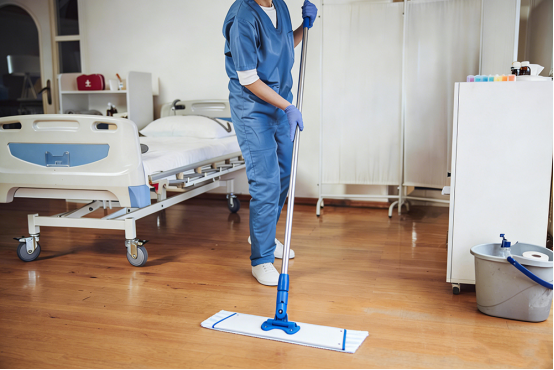
Buying a mop pad for a hospital is not the same as buying one for an office. The pad becomes part of a larger cleaning system that includes the frame, handle, detergent or disinfectant, roomchange procedure, staff training, storage, and waste handling.
This is why the lowest unit price rarely tells the whole story. A pad that does not fit the existing frame, releases liquid unevenly, or breaks down in the chosen chemistry can create more work for environmental services teams and may increase the cost per cleaned room.
For hospital, clinic, rehabilitation center, and nursing home buyers, the practical question is: Will this pad work reliably in our facility's real cleaning process?
The following checklist can help procurement, infection prevention, and environmental services teams evaluate disposable microfiber mop pads before committing to a larger order.
1. Start with the cleaning application, not the product catalogue
Define where and how the mop pad will be used before comparing quotations.
Important questions include:
Is the pad intended for patient rooms, corridors, bathrooms, isolation areas, operating areas, or general public spaces?
Will it be used for routine cleaning, cleaning followed by disinfection, or a combined detergentdisinfectant process?
Is the facility planning to use one pad per room, one pad per defined area, or another controlled change protocol?
What floor surfaces are present?
Which mop frames and handles are already in use?
How will clean pads be prepared, transported, separated from used pads, and discarded?
CDC guidance recommends that healthcare facilities create cleaning schedules that identify the responsible staff, frequency, products, methods, and detailed procedures for each patientcare area. In other words, the mop pad should support the facility's established protocol rather than determine it. See the CDC's guidance on [environmental cleaning procedures](https://www.cdc.gov/healthcareassociatedinfections/hcp/cleaningglobal/procedures.html).
2. Confirm frame fit before evaluating price
Disposable mop pads use different attachment methods, including pockets, hookandloop backing, tabs, and other proprietary constructions. Similarlooking pads are not automatically interchangeable.
Ask the supplier to confirm:
Finished pad dimensions and dimensional tolerance
Attachment method
Compatible frame dimensions
Whether the pad remains secure when fully wet
Whether samples can be tested on the facility's existing frames
A small sample trial is more useful than relying only on a catalogue description. During the trial, ask cleaning staff whether the pad is easy to attach while wearing gloves, whether the edges curl, and whether it stays in position around beds, corners, and bathroom fixtures.
3. Check compatibility with the facility's cleaning chemistry
Microfiber is commonly selected because it can collect soil effectively, but not every microfiber construction performs the same way with every chemical.
Before approval, give the supplier the exact detergent and disinfectant information used by the facility. Ask for written compatibility information covering:
Active chemical type
Inuse concentration
Expected wet contact time
Exposure period before use if pads are preprepared
Any effect on pad strength, backing, adhesive, absorbency, or liquid release
CDC guidance notes that microfiber may be damaged by highpH products and may not be compatible with some chlorinebased chemistry. It also stresses following product labels and manufacturer instructions for preparation and use. See the CDC overview of [cleaning supplies and equipment](https://www.cdc.gov/healthcareassociatedinfections/hcp/cleaningglobal/suppliesandequipment.html).
Do not accept a broad statement such as “compatible with disinfectants” when the facility uses a specific formulation. Compatibility should be assessed against the actual working solution and process.
4. Evaluate liquid pickup and release under realistic conditions
Absorbency alone is not enough. A pad can hold a large amount of liquid but distribute it poorly, or it can release too much at the start and leave the final part of the floor insufficiently wet.
During a pilot, compare:
Amount of solution picked up during preparation
Evenness of release across the test area
Coverage achieved before the pad needs to be changed
Ability to maintain the disinfectant label's required wet contact time
Drag when wet
Soil pickup at the end of the cleaning pass
Lint or visible fiber release
Use the same floor type, solution, preparation method, and staff instructions for every candidate. Recording the results on a simple scorecard makes supplier comparisons more objective.
5. Decide whether disposable or reusable pads fit the workflow
Disposable pads can simplify changeover and remove the need to launder the pad after use. Reusable pads may reduce purchasing volume but require validated collection, laundering, drying, storage, and qualitycontrol processes.
Neither option is automatically right for every facility.
Disposable pads may be particularly useful when:
The facility follows a onepadperroom or controlledarea protocol
Used textiles are difficult to transport or segregate
Laundry capacity is limited
A temporary ward or outbreakresponse plan requires a simple workflow
The cost and consistency of reprocessing are difficult to control
Reusable pads may deserve consideration when:
A reliable laundry process is already available
Pads can be separated, processed, dried, inspected, and stored correctly
The facility can monitor degradation over repeated cycles
Waste reduction is a major procurement objective
The decision should be made with infection prevention, environmental services, procurement, and wastemanagement stakeholders—not by procurement alone.
6. Compare total cost per cleaned room
Unit price is only one part of the cost. A more useful comparison is the total cost per room or per square meter cleaned.
Include:
Pad purchase price
Freight and import costs
Storage space
Number of pads used per shift
Preparation time
Labor required to change pads
Laundry, water, energy, and detergent costs for reusable systems
Collection bags and internal transport
Rejection, breakage, and replacement rates
Waste handling for disposable systems
For example, a slightly more expensive pad may have a lower operating cost if it fits the frame consistently and covers the required area without detaching. The opposite can also be true: paying for higher theoretical absorbency provides little value if the facility's protocol requires a pad change after every room.
Ask suppliers to provide the data needed for your own calculation rather than presenting a universal costsaving percentage.
7. Request documents that match the claims
A professional quotation should make it possible to verify important product claims.
Depending on the product and market, buyers may request:
Technical data sheet
Material composition
Product dimensions and tolerances
Instructions for use or recommended operating procedure
Chemical compatibility information
Relevant test reports, including the test method and tested sample
Lot or batch identification approach
Qualitymanagement information
Packaging specification
Shelflife or storage requirements, if applicable
Countryspecific regulatory or tender documents
Check that the model name on a test report matches the product being quoted. “Tested material” does not always mean that every finished product configuration has been tested.
For antimicrobial, biodegradable, compostable, recycledcontent, or similar claims, ask exactly what was tested, under which standard, by which laboratory, and what limitations apply. Avoid treating a marketing term as a technical specification.
8. Review packaging and supply continuity
Healthcare buyers need products that arrive clean, identifiable, and ready to enter the facility's distribution workflow.
Confirm:
Quantity per bag and carton
Whether inner packaging is sealed
Carton dimensions and gross weight
Lot coding and productiondate format
Pallet configuration
Storage conditions
Standard lead time
Monthly production and delivery capacity
Procedure for urgent or partial shipments
Changenotification process for materials, construction, or packaging
For nursinghome groups and hospital networks, also ask whether multiple sites can receive the same specification and lot documentation. Consistency between deliveries may be more valuable than a small difference in unit price.
9. Run a controlled pilot with the people who use the product
A purchasing team can check documents and pricing, but cleaning staff will notice handling problems first.
A practical pilot can include:
1. Confirming compatibility with the existing frame and cleaning solution.
2. Preparing each candidate pad using the same procedure.
3. Testing on the same floor types and room categories.
4. Recording coverage, wetness, drag, attachment security, and visible soil pickup.
5. Asking environmental services staff for structured feedback.
6. Reviewing results with infection prevention and occupational safety personnel.
Document both positive and negative results. If the supplier later changes the material or construction, the approved sample and scorecard provide a useful reference.
10. Questions to include in an RFQ
The following questions can be copied into a request for quotation:
1. What are the pad's finished dimensions and tolerance?
2. Which mopframe dimensions and attachment systems are compatible?
3. What is the complete material composition?
4. Which detergents and disinfectant chemistries have been evaluated?
5. What preparation method does the supplier recommend?
6. What relevant test reports are available, and which exact product was tested?
7. Can preproduction or currentproduction samples be supplied?
8. How is each production lot identified and inspected?
9. What are the innerpack and carton quantities?
10. What are the standard lead time, minimum order quantity, and production capacity?
11. Can packaging, color, size, or attachment design be customized?
12. How are product or rawmaterial changes communicated to customers?
A balanced procurement decision
Disposable microfiber mop pads can support a clear and repeatable roomchange workflow, but the product must be evaluated as one part of the facility's environmentalcleaning system. Frame fit, chemical compatibility, liquid release, documentation, packaging, staff handling, and total operating cost all matter.
The strongest supplier is not simply the one with the lowest quotation. It is the supplier that can answer technical questions clearly, provide matching documentation, maintain consistency, and support a realistic prepurchase trial.
ESUN supplies a range of [medical disposable microfiber mop pads](https://www.esunclean.com/medicaldisposablemoppad) for healthcare cleaning applications. Buyers can contact the team to discuss dimensions, attachment options, packaging, samples, and documentation for a specific project.