 EN
EN

How Often Should Hospital Privacy Curtains Be Replaced? A Buyer’s Guide
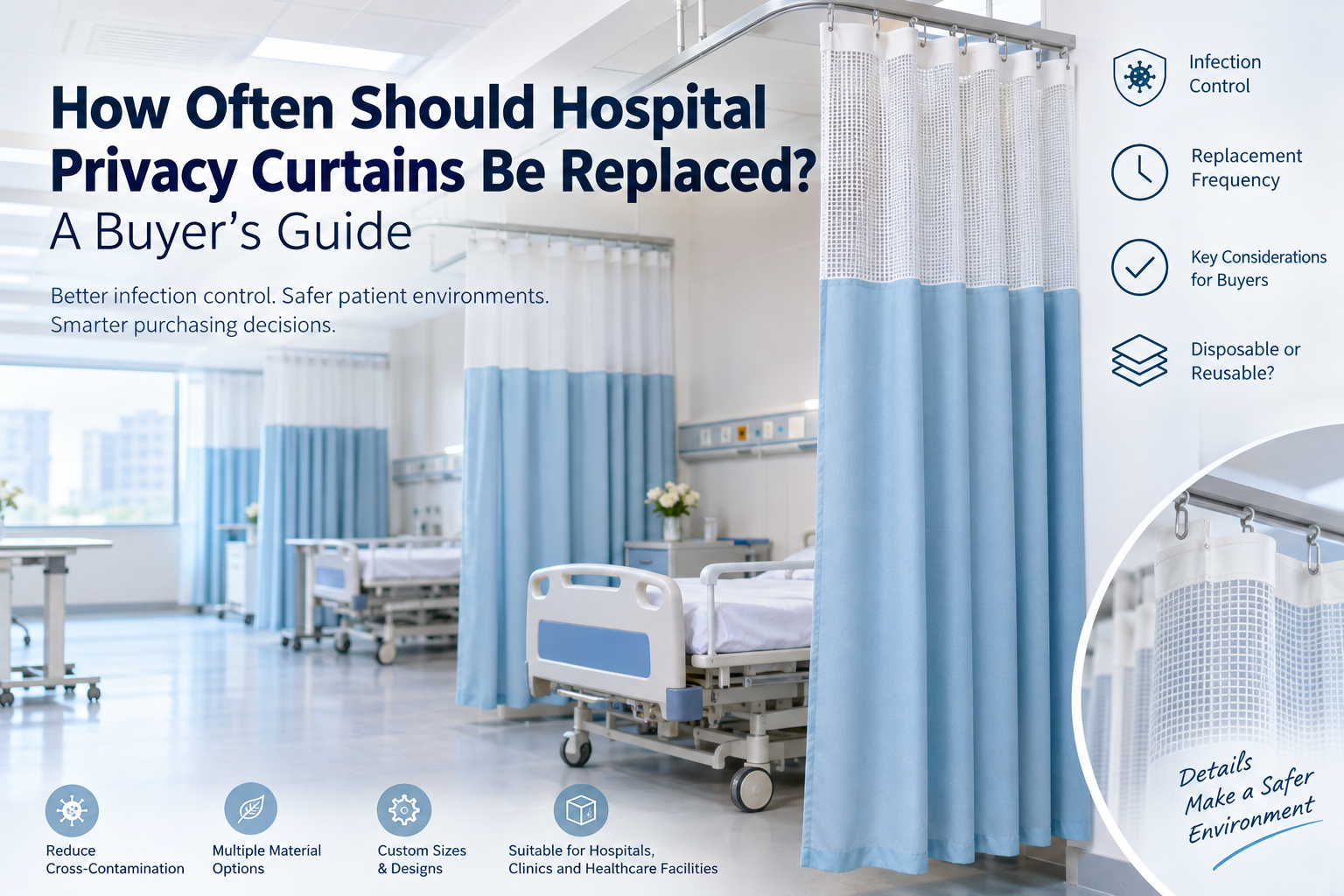
Hospital privacy curtains are easy to overlook.
They do not look like medical equipment, and they are not normally the first item discussed in an infection-control meeting. But in a busy patient room, the edge of a privacy curtain may be touched repeatedly by nurses, cleaners, patients and visitors.
That makes curtain replacement more than a housekeeping question.
For hospital procurement teams, healthcare distributors and facility managers, the real question is:
How often should hospital privacy curtains actually be changed?
There is no single replacement interval that works for every hospital.
A better approach is to combine a planned replacement schedule with clear “change immediately” conditions based on contamination risk, patient turnover and the clinical environment.
Short Answer: When Should Hospital Privacy Curtains Be Replaced?
Hospital privacy curtains should generally be replaced or removed for laundering when:
-
They are visibly soiled or contaminated
-
They have been exposed to blood or body fluids
-
A patient under certain transmission-based precautions is discharged or transferred
-
There is an outbreak or elevated infection risk
-
The curtain is damaged, stained or difficult to clean
-
The facility reaches its scheduled replacement interval
-
The curtain no longer meets the hospital’s hygiene or appearance standard
CDC environmental-cleaning guidance identifies privacy-curtain edges as high-touch areas and recommends healthcare facilities use a risk-based cleaning program. CDC guidance for certain isolation situations also recommends removing privacy curtains for laundering after patient transfer or discharge.
That means hospitals should avoid relying on only one rule such as “change every six months.”
The clinical situation matters.
Why Privacy Curtains Need More Attention Than Many Buyers Expect
The problem is not the whole curtain.
It is usually the leading edge — the area people grab when opening or closing it.
Research has shown that hospital privacy curtains can become contaminated relatively quickly.
In one longitudinal study involving 43 curtains, 12 of 13 newly placed curtains became contaminated within one week, and 95% of curtains sampled showed contamination at least once during the study. The organisms detected included MRSA and VRE.
Another study in a burns and plastic surgery unit found that bacterial contamination increased over time, with MRSA appearing on some curtains between approximately days 10 and 14.
These studies do not mean every curtain must automatically be discarded after 7 or 14 days.
They do show why a privacy curtain should not be treated as a purely decorative textile.
For procurement teams, this changes the purchasing conversation from:
“How cheap is the curtain?”
to:
“How will this curtain fit into our infection-prevention and replacement process?”
Is There a Standard Replacement Frequency?
There is no universal global rule requiring every hospital privacy curtain to be replaced after exactly 30, 60 or 90 days.
Different healthcare facilities use different protocols.
Some hospitals follow scheduled replacement.
Others rely more heavily on terminal cleaning, isolation-room procedures or visible contamination.
CDC's environmental-cleaning procedures include scheduled cleaning of bed curtains and recommend removing privacy curtains for laundering after patient transfer or discharge in certain precaution settings.
The safest purchasing approach is therefore to build a policy around risk level, rather than simply copying a calendar interval.
A Practical Replacement Framework for Hospital Buyers
For procurement and infection-control teams, it helps to separate replacement into four situations.
1. Routine Patient Areas
Examples include:
-
General wards
-
Rehabilitation areas
-
Long-term care rooms
-
Standard inpatient rooms
In these areas, curtains may follow the hospital’s scheduled cleaning or replacement program unless they become visibly contaminated earlier.
The key is to document the schedule and make responsibility clear.
Who checks the curtain?
Who removes it?
Who records the replacement?
Who makes sure new curtains are available?
A good curtain policy only works if procurement, EVS and clinical teams can actually follow it.
2. Isolation and High-Risk Rooms
Higher-risk areas may require more frequent curtain changes.
Examples include rooms used for:
-
Contact precautions
-
Droplet precautions
-
Certain airborne precautions
-
Patients with known transmissible infections
-
High-risk immunocompromised patients
CDC cleaning guidance states that after patient transfer or discharge, privacy and window curtains should be removed for laundering in certain transmission-based precaution settings.
During norovirus outbreaks, CDC also recommends changing privacy curtains when visibly soiled and after patient discharge or transfer.
For these environments, waiting for a routine monthly or quarterly schedule may not be enough.
3. Visible Contamination
This is the simplest rule:
If the curtain is visibly contaminated, do not wait for the scheduled replacement date.
Visible contamination may include:
-
Blood
-
Body fluids
-
Vomit
-
Heavy staining
-
Food contamination
-
Other obvious soiling
The curtain should be handled according to the hospital’s infection-control and laundry/disposal procedure.
4. Outbreak Situations
Outbreaks change normal operating conditions.
During an outbreak, hospitals may temporarily shorten replacement intervals or change curtains after each patient discharge.
This is where disposable privacy curtains can become operationally useful.
Instead of removing a reusable curtain, transporting it to laundry, tracking it and reinstalling it later, staff can remove and replace a disposable panel quickly.
That does not mean disposable curtains automatically replace every reusable curtain.
It means they can simplify certain high-turnover or high-risk workflows.
Disposable vs Reusable Hospital Curtains: Which Is Easier to Manage?
This is one of the most common questions distributors and hospital buyers ask.
The answer depends on how the hospital manages laundry and room turnover.
Reusable Privacy Curtains
Reusable curtains are typically made from polyester or similar durable fabrics.
They may be suitable for facilities that already have:
-
Centralized laundry
-
Curtain tracking systems
-
Scheduled removal procedures
-
Sufficient replacement stock
-
Staff available for curtain removal and reinstallation
Their advantage is long-term reuse.
Their disadvantage is that every cleaning cycle creates additional handling.
Someone has to:
Remove the curtain → transport it → launder it → inspect it → store it → reinstall it.
For large hospitals, that process is not always as simple as it looks on paper.
Disposable Privacy Curtains
Disposable hospital curtains are generally used for a defined service period and then removed and discarded according to facility policy.
Their advantages include:
-
Fast replacement
-
No laundering
-
Reduced textile handling
-
Easier stock control
-
Convenient use in isolation and high-turnover rooms
-
More predictable replacement procedures
For facilities trying to simplify environmental-cleaning workflows, disposable curtains can therefore be attractive.
Should Hospitals Change Curtains After Every Patient?
Not necessarily.
A general ward with low-risk patient turnover may not need a new curtain after every patient.
However, patient discharge or transfer becomes more important when:
-
The patient is under transmission-based precautions
-
The curtain is visibly contaminated
-
The hospital is responding to an outbreak
-
Local infection-control policy requires replacement
This distinction is important.
Replacing every curtain after every patient regardless of risk can create unnecessary cost.
Leaving curtains unchanged for long periods without inspection can create another problem.
A risk-based policy sits between these two extremes.
What Should Hospital Buyers Ask Suppliers?
When purchasing hospital privacy curtains, buyers should not only ask about size and price.
The curtain should fit the facility’s replacement system.
Here are the specifications worth checking.
1. Curtain Material
Common options include:
-
Disposable polypropylene nonwoven
-
SMS or SMMS nonwoven
-
Reusable polyester fabric
-
Antimicrobial-treated materials
Material affects durability, handling, weight, cleanability and replacement strategy.
2. Fire-Retardant Requirements
Fire safety requirements vary by market and facility.
Healthcare buyers should confirm which standard applies to their project before ordering.
Depending on the country and application, suppliers may be asked about standards such as:
-
NFPA 701
-
BS 5867
-
Other local fire-performance requirements
Do not assume that one certification automatically covers every hospital market.
3. Antimicrobial Performance
Some hospital curtains use antimicrobial treatments.
These treatments may help reduce microbial growth on the material, but they should not be treated as a substitute for proper curtain replacement, cleaning and hand hygiene.
Buyers should ask:
-
Which test method was used?
-
Which organisms were tested?
-
How long does the treatment remain effective?
-
Does performance change after washing?
4. Curtain Dimensions
Hospitals should confirm:
-
Curtain height
-
Curtain length
-
Ceiling-track height
-
Required floor clearance
-
Mesh height
-
Panel overlap
Incorrect sizing can create installation problems even if the curtain material itself is good.
5. Hook and Track Compatibility
Curtains should be compatible with the hospital’s existing ceiling track.
For replacement projects, this is especially important.
Changing the entire track system just to install a new curtain can add unnecessary cost.
6. Replacement Speed
Ask a practical question:
How long does it take a staff member to remove and install one curtain?
For a hospital changing hundreds of curtains, installation time matters.
Snap-panel systems, pre-installed hooks or simplified attachment designs may reduce labor time.
7. Packaging and Identification
For larger hospital projects, individual curtain identification can make inventory management easier.
Useful options may include:
-
Room labels
-
Size labels
-
Color coding
-
Batch information
-
Installation date fields
-
Private-label packaging
This is particularly helpful for distributors managing multiple hospital accounts.
How Can Buyers Build a Better Curtain Replacement Program?
A good curtain purchasing program usually combines three things:
Defined replacement rules + suitable curtain design + reliable inventory
Procurement teams can create a simple internal matrix.
For example:
| Area | Replacement Trigger | Curtain Type |
|---|---|---|
| General ward | Scheduled interval or visible contamination | Reusable or disposable |
| Isolation room | Discharge/transfer according to IPC policy | Disposable often practical |
| ICU | Risk-based and facility policy | Disposable or antimicrobial |
| Emergency department | High-touch/high-turnover assessment | Disposable may simplify changes |
| Long-term care | Scheduled inspection and contamination-based replacement | Reusable or disposable |
The exact frequency should be determined by the facility's infection-prevention team.
The important point is that procurement should know the intended use before choosing the curtain.
Why Disposable Curtains Are Increasingly Considered for High-Turnover Areas
For many buyers, the attraction of disposable hospital curtains is not simply “better infection control.”
It is workflow.
A disposable curtain can help remove several steps associated with reusable textiles:
No laundry collection.
No washing cycle.
No return logistics.
No waiting for clean curtains.
No uncertainty about how many clean curtains are currently available.
This can be especially useful for:
-
Isolation rooms
-
Emergency departments
-
Temporary wards
-
High-turnover beds
-
Outbreak response
-
Renovation projects
-
Facilities without centralized textile processing
The decision should still be based on total operating cost rather than only purchase price.
What Is the Real Cost of a Hospital Privacy Curtain?
When comparing disposable and reusable curtains, buyers should avoid comparing only unit price.
For reusable curtains, total cost may include:
-
Purchase cost
-
Laundry
-
Labor
-
Transport
-
Storage
-
Inspection
-
Repair
-
Replacement inventory
For disposable curtains, cost may include:
-
Curtain cost
-
Installation labor
-
Disposal
-
Storage
-
Replacement frequency
This is why two curtains with very different unit prices may have a much smaller difference in total operating cost.
For large hospital or healthcare-distributor projects, it is often better to compare cost per room per year rather than cost per curtain.
FAQ
How often should a hospital privacy curtain be changed?
There is no universal replacement interval for every healthcare facility. Curtains should be changed according to facility policy, risk level, visible contamination, isolation procedures and patient turnover.
Should hospital curtains be replaced when a patient is discharged?
In certain transmission-based precaution environments, CDC guidance recommends removing privacy curtains for laundering after patient transfer or discharge. Facility infection-control policy should determine the final procedure.
Can hospital privacy curtains carry bacteria?
Yes. Studies have found rapid bacterial contamination on frequently touched areas of hospital privacy curtains, including MRSA and VRE in some clinical settings.
Are disposable hospital curtains more hygienic than reusable curtains?
Disposable curtains can simplify replacement and eliminate laundering, but infection-control performance still depends on correct handling and replacement protocols.
When should a curtain be replaced immediately?
Replace or remove the curtain when it is visibly contaminated, damaged, involved in certain isolation-room discharge procedures or when required by outbreak or facility policy.
Are antimicrobial curtains enough to prevent contamination?
No. Antimicrobial materials may provide additional protection, but they do not replace hand hygiene, environmental cleaning or appropriate curtain replacement.
Final Recommendation for Healthcare Buyers
There is no single “correct” number of days that every hospital privacy curtain should remain in use.
For procurement teams, a better question is:
What replacement policy matches the risk level of each hospital area?
A general ward, ICU, isolation room and emergency department do not necessarily need the same curtain strategy.
Before purchasing, buyers should evaluate:
Patient risk → Touch frequency → Replacement workflow → Material → Fire performance → Installation method → Total operating cost
For many healthcare facilities, a mixed system can work well:
Reusable curtains in lower-risk areas and disposable curtains in high-turnover or higher-risk environments.
E-SUN supplies customizable disposable and reusable hospital privacy curtains for hospitals, healthcare distributors and OEM projects, with options including polypropylene nonwoven, SMS/SMMS materials, polyester fabrics, mesh panels, printing, color customization, hook systems and snap-panel designs.